
Why the most dangerous knowledge in your enterprise is the knowledge no one wrote down and why AI won’t save you from losing it.
by Nadzeya Stalbouskaya
There is a question that surfaces in almost every transformation programme I have worked on, and it is never asked out loud. It gets asked in side conversations, in the pause before a migration, in the silence after someone senior gives notice. The question is this: why does this system look the way it does?
Not what it does. Not how it works. Why. Why was this service split off in 2019? Why does the ERP integration route through that one middleware layer everyone is afraid to touch? Why did we choose data mesh here and a centralised warehouse there? Somebody knew, once. The decision was deliberate, contextual, often correct. But the reasoning rarely made it into a diagram, and the person who held it has moved on.
This is the part of enterprise architecture nobody puts on a slide: architecture is not primarily a record of what your systems are. It is the memory of why you decided they should be that way and most organisations are losing that memory faster than they are creating it.
The discipline we mislabel
We have spent a decade describing enterprise architecture as a documentation discipline. We build repositories, we draw landscapes, we maintain catalogues of capabilities and applications. All of that is useful. None of it is the point.
The point is that an enterprise is a sequence of decisions made under constraints that no longer exist. The constraints expire the vendor contract ends, the regulation changes, the headcount triples, but the decisions they produced live on in the architecture, frozen, with the reasoning stripped out. What you are left with is a system that behaves like an archaeological site: layer upon layer of choices, each one rational in its moment, none of it explained.
Enterprise architecture, done well, is the company’s memory of those moments. Not the artefact, the memory. The repository is where the memory is supposed to be stored. The tragedy of most repositories is that they store the conclusion and discard the argument. They tell you the wall is here, but they never tell you what the wall was holding back.
Knowledge that never reaches the diagram
Here is the uncomfortable truth I keep running into. The most important architectural knowledge in any organisation is not in the architecture documents. It is in people’s heads, and it is largely invisible until the moment it disappears.
Think about what a diagram actually captures. It captures structure: boxes, lines, protocols, ownership boundaries. What it cannot capture is the texture of the decision. The vendor who promised a feature that never shipped, so a workaround became permanent. The political compromise between two business units that explains an otherwise inexplicable data duplication. The outage in 2021 that is the real reason for a retry pattern nobody documented as a retry pattern. The fact that a “temporary” service is load-bearing for a downstream report that finance runs every quarter and architecture has never heard of.
This is the hidden layer of architecture: the reasoning, the history, the accumulated context that explains the diagram but never appears in it. What’s more, it is hidden not because anyone is hiding it, but because our tools and our rituals were never designed to capture it. We document the what with discipline and the why by accident.
The result is a peculiar kind of fragility. On paper, your architecture is well-governed: every system has an owner, every interface is catalogued, every standard is published. In reality, the load-bearing knowledge is undocumented, informal, and concentrated in a small number of people who have simply been there long enough. You have governed the visible and lost the invisible.
And let’s be honest about our share of the blame. Architects love diagrams. We argue about notation. We debate frameworks. We will spend an hour deciding whether something is a component or a service. And then we forget to write down the single thing the next generation will actually need: why did we decide this? We treat the rationale as the one part of the work too obvious to record which is exactly why it is the first thing to vanish.
When a person leaving is worse than a server failing
We have built an entire discipline around resilience. We design for the failure of infrastructure with real rigour: redundancy, failover, disaster recovery, chaos engineering. We assume any given server can die at any moment, and we architect so that it doesn’t matter.
We do almost nothing equivalent for the failure of memory.
A server failing is a solved problem. You have a runbook, a replica, a recovery time objective. The system is designed so that the loss is survivable, often invisible. But when a senior architect leaves the one who held the why of three critical platforms in their head there is no replica. There is no failover. There is no recovery time objective for institutional knowledge, because we have never treated that knowledge as infrastructure.
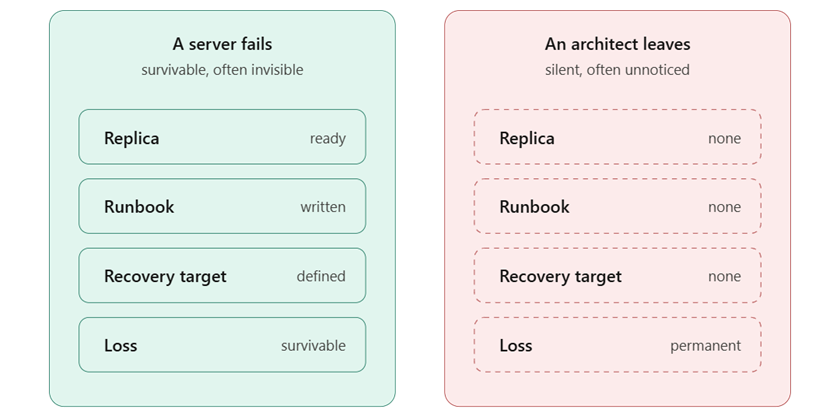
So the most dangerous single point of failure in many enterprises is not a server. It is not a database. It is a person and not because they are irreplaceable in their skills, but because they are the last living index of decisions that were never written down. When they go, the organisation does not lose a contributor. It loses the ability to understand its own systems. The diagrams remain. The meaning leaves with them.
Let me make this concrete, because I have watched it happen. In one organisation I worked with, a critical integration had been running for more than ten years. Nobody wanted to touch it. The original architect had left long before. Documentation existed. Interface contracts existed. By every measure that shows up in a governance review, the system was well-managed. But nobody remembered why the integration bypassed the standard middleware. The reason had walked out of the building years earlier.
During a migration, the team did the sensible thing. They saw a workaround that violated the standard pattern, found no rationale recorded anywhere, and assumed it was obsolete. So they removed it and routed the integration through the proper middleware, as the architecture said they should. Two weeks later, finance lost visibility of its quarterly reconciliation data. The bypass had never been a workaround. It was a deliberate decision, made for a reason that was completely correct and completely undocumented and the diagram that showed the integration in perfect detail was exactly what gave the team the confidence to break it.
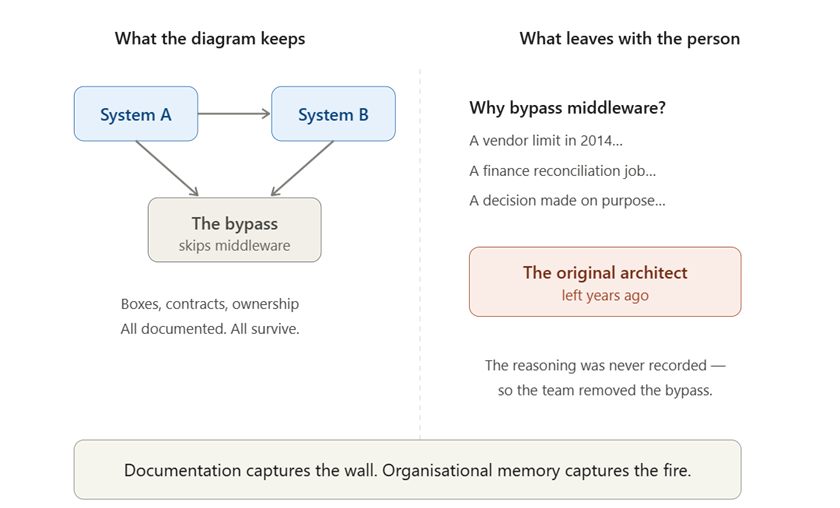
This is the inversion I want architects to sit with: we have made our hardware immortal and left our knowledge mortal. We obsess over the resilience of things that can be rebuilt and ignore the resilience of the one thing that cannot.
The numbers around workforce mobility only sharpen the point. Tenure is short and getting shorter; people change roles every few years; the analysts who study institutional knowledge keep raising the same flag. But I do not need a report to tell me what I have already seen on the ground: the assumption that the people who understand your architecture will still be there to explain it, is no longer safe. It may never have been.
The AI promise and the trap inside it
This is the moment where someone says: surely AI fixes this. We have large language models that can ingest entire codebases, summarise documentation, answer questions about systems in natural language. Won’t AI simply become the organisational memory?
I want to be precise here, because the answer is not a flat no, and the optimism is not entirely misplaced. AI is genuinely good at one half of the problem. It can read what is written. It can index what is captured. It can make the recorded knowledge of an organisation far more accessible than any wiki or repository ever did. If the knowledge exists somewhere in text, AI can help you find it, connect it, and ask questions of it. That is real value, and architects should use it.
But here is the trap. AI does not capture the knowledge that was never recorded. It cannot reason about the vendor promise that lived only in a hallway conversation, the political compromise that was never minuted, the outage whose lesson was absorbed but never written. AI is extraordinary at retrieving and recombining what exists. It is, by definition, blind to what does not.
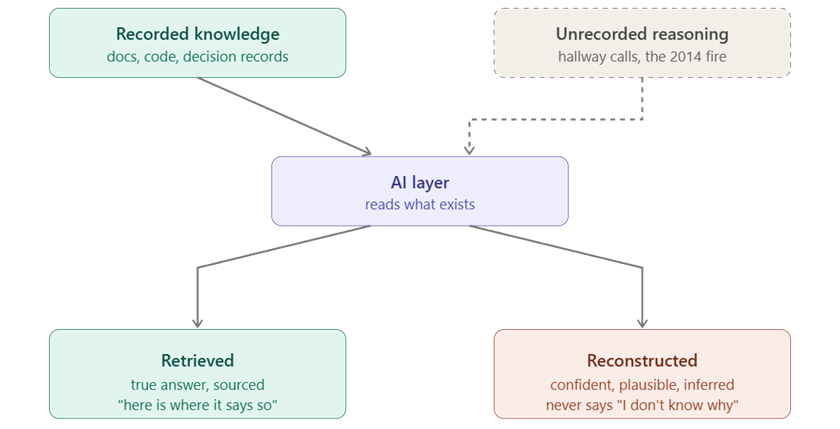
And there is a second, subtler danger. AI is fluent. It will produce a confident, plausible explanation of why your system looks the way it does and that explanation will be a reconstruction, not a memory. It will infer intent from structure, which is precisely the inference that loses the texture I described earlier. The model will tell you the wall is load-bearing because it connects two rooms. It will not tell you the wall is there because of a fire in 2014, because nobody told the model about the fire.
So AI does not replace organisational memory. It does something more double-edged: it amplifies whatever memory practice you already have. If your organisation captures its reasoning well, AI makes that reasoning radically more useful. If your organisation captures only conclusions and loses the arguments, AI will confidently paper over the gaps with reconstructions that feel like memory and are not. The discipline of capturing the why matters more in the age of AI, not less, because the cost of not capturing it is now hidden behind a fluent, authoritative interface that never says “I don’t know why.”
What this asks of architects
If you accept that enterprise architecture is organisational memory, then the job changes shape. It stops being primarily about producing accurate diagrams and starts being about preserving decisions in a form that survives the people who made them.
That is a different practice. It means treating the rationale as a first-class artefact, not a footnote, capturing not just what was decided but what was traded away, what was rejected, and under what constraints. It means making decision records as routine as deployment pipelines, so the reasoning is written down while it is still alive rather than reconstructed after it is gone. It means recognising that an architecture review is not a quality gate on diagrams, but a memory-creation event, and treating it that way.
It also means changing how we measure architectural risk. We are fluent in the language of technical risk coupling, latency, single points of infrastructure failure. We are almost silent on the language of memory risk. Yet the question “if this person left tomorrow, which decisions would become unexplainable?” is one of the most important risk questions an organisation can ask, and almost no one asks it systematically. The architects who will matter over the next decade are the ones who treat that question as core to the discipline, not adjacent to it.
There is a version of this work that looks unglamorous writing down why, insisting on rationale, refusing to let a decision pass without recording the argument behind it. It does not produce elegant diagrams. It produces something more valuable: an organisation that can still understand itself after the people who built it have gone.
The wall and the fire
Come back to the wall. Every enterprise architecture is full of walls: services, boundaries, integrations, standards. Each one put there by someone, for a reason, in response to a fire we can no longer see. The diagram shows you every wall with perfect fidelity. It tells you nothing about the fires.
Architecture as documentation captures the walls. Architecture as organisational memory captures the fires. The first is what we have built our discipline to do. The second is what our organisations actually need from us, and what they are quietly, steadily losing.
Most organisations think their greatest architectural risk is legacy technology. I suspect it is forgotten decisions. Technology can be rebuilt. Lost understanding rarely can.
The systems will outlive the people who designed them. The only question is whether the understanding outlives them too. That is not a technical problem, and it is not one AI will solve for you. It is a discipline and it starts the next time you make a decision worth remembering, by writing down not just what you chose, but why.This piece is for the architects, CTOs, and transformation leaders who suspect that their most valuable system documentation is walking out the door one resignation at a time. It is an invitation to rethink what we believe architecture is for.
About the Author

Nadzeya Stalbouskaya is an award-winning Technology Architect, prolific author, and recognized international conference speaker. With numerous publications across respected global journals and magazines, she is widely regarded as one of the emerging voices shaping the future of enterprise architecture and digital transformation. Nadzeya is an active member of leading industry organizations, serving as ambassador and advisor to global communities where she promotes knowledge exchange, governance excellence, and innovative architectural thinking. She has spoken at some of the most prestigious events in Europe, inspiring thousands of professionals with practical strategies for addressing architecture debt, building resilient systems, and accelerating business transformation.
Her approach? Strategy. Architecture. Elegance of approach.