
Why Supply Chain Is Becoming the New Front Door to Enterprise Architecture
For many years, Enterprise Architecture conversations largely revolved around familiar themes: application portfolios, standards, governance models, target states, technology modernization, and strategic roadmaps. Even transformation programs, despite ambitious rhetoric, often remained bounded by departmental perspectives and isolated optimization efforts. Supply chain discussions, meanwhile, were frequently viewed as operational disciplines centered on logistics, inventory, procurement, manufacturing, and planning. Yet something profoundly different emerged at the Gartner Supply Chain Conference 2026 held in Orlando, Florida May 4-6.
Beneath the expected discussions around planning automation, orchestration platforms, AI-enabled forecasting, digital control towers, and integrated business management was a much larger story about the enterprise itself. The conference increasingly described organizations not as static structures composed of departments and systems, but as dynamic ecosystems that must continuously coordinate decisions, synchronize intelligence, adapt to volatility, and orchestrate activity across interconnected internal and external networks.
In many respects, the conference revealed that supply chain is becoming one of the first major domains where the future form of the enterprise is being operationally tested. This matters enormously for Enterprise Architecture and Solutions Architecture because the underlying problems being addressed are no longer merely operational. They are fundamentally architectural.
The modern supply chain now forces organizations to confront realities that many enterprises have historically struggled to address coherently:
- cross-functional synchronization
- ecosystem interoperability
- multi-enterprise collaboration
- AI-enabled decision coordination
- adaptive planning
- real-time governance
- continuous transformation
- orchestration across distributed environments
The complexity of modern operating environments has become too interconnected for fragmented thinking to survive. The pace of disruption has become too fast for static organizational coordination models. The rise of AI and autonomous decision systems has amplified the importance of synchronized governance and intelligence. And the increasing dependence on ecosystem partners has forced organizations to recognize that they are no longer operating as isolated enterprises, but rather as participants within continuously evolving business ecosystems.
One of the most important signals of this shift appeared in the recurring emphasis on creating “an enterprise that decides as one.” While the phrase may initially sound operational, its implications are deeply architectural. Historically, enterprises focused heavily on optimizing workflows and improving execution efficiency within individual functions. But the emerging challenge is no longer simply how to execute faster within silos. The challenge is how to synchronize decisions coherently across the enterprise ecosystem itself. That distinction is transformative.
The enterprise of the future may ultimately be defined less by how efficiently it performs isolated activities and more by how effectively it harmonizes decisions across changing operational conditions. This changes the nature of architecture entirely. Enterprise Architecture can no longer remain primarily concerned with static structures and disconnected governance reviews. Increasingly, it must evolve toward enabling coordinated enterprise orchestration.
This evolution from integration to orchestration may represent one of the most significant themes visible throughout SCC 2026. For years, integration was often treated as the dominant enterprise challenge. Organizations focused on connecting systems, synchronizing data, eliminating duplication, and streamlining interfaces. Those concerns remain important, but orchestration introduces a much broader and more sophisticated challenge. Integration connects. Orchestration harmonizes. That difference is profound.
Orchestration requires the coordinated alignment of people, platforms, workflows, AI systems, governance mechanisms, external partners, operational constraints, and strategic objectives in ways that continuously adapt to changing circumstances. The conference repeatedly emphasized this through discussions around orchestration platforms, multi-enterprise collaboration networks, ecosystem partnerships, synchronized planning environments, and digital control towers.
In many ways, supply chain is now exposing the limitations of traditional enterprise thinking. Static architectures, fragmented governance, and isolated transformation initiatives struggle to cope with environments characterized by constant disruption, ecosystem interdependence, and accelerating AI-driven change. One Gartner statement captured this reality succinctly: “Transformation has no finish line.” That single observation carries enormous implications for Enterprise Architecture.
Traditional EA practices often relied heavily on baseline architectures, target architectures, and phased roadmaps that assumed environments evolved at relatively manageable speeds. But modern supply chains no longer operate within stable and predictable boundaries. Instead, organizations must continuously respond to geopolitical shifts, changing customer expectations, supply disruptions, ecosystem dependencies, emerging technologies, and increasingly volatile operational environments. As a result, architecture itself must become more adaptive, more intelligence-driven, and more continuously synchronized with operational reality.
The future likely belongs to enterprises capable not merely of documenting structures, but of continuously sensing, interpreting, coordinating, simulating, governing, and orchestrating change while transformation is actively occurring. This represents a significant shift away from static repository-centric thinking toward continuous architecture intelligence.
The growing role of AI further amplifies this challenge. Throughout the conference, organizations repeatedly discussed AI-enabled planning, autonomous orchestration, decision automation, and intelligent operational response systems. Yet the conference also revealed an important underlying concern: technology alone does not create enterprise coherence. In fact, AI may amplify fragmentation when architectural synchronization is weak.
One of the most revealing observations presented during the event was the statement that “Misalignment is the hidden tax on AI value.” That insight extends far beyond supply chain. Across the conference, alignment repeatedly emerged as a central concern: CIO-CSCO coordination, integrated business planning alignment, ecosystem synchronization, cross-functional governance, and enterprise-wide decision coherence.
This exposes one of the major misconceptions surrounding modern transformation initiatives. Many organizations continue pursuing isolated AI use cases, disconnected automation projects, and fragmented digital initiatives while assuming that technological acceleration alone will create enterprise agility. But without harmonized governance, synchronized operating models, coordinated decision frameworks, and coherent enterprise architecture, AI often accelerates complexity faster than organizations can absorb it. The challenge is therefore not merely technological enablement. The challenge is enterprise synchronization.
This is why Enterprise Architecture is becoming increasingly important again — but only if it evolves beyond traditional static governance and documentation models. The orchestrated enterprise requires architecture disciplines capable of harmonizing strategy, operations, AI, ecosystems, governance, value delivery, and continuous adaptation simultaneously.
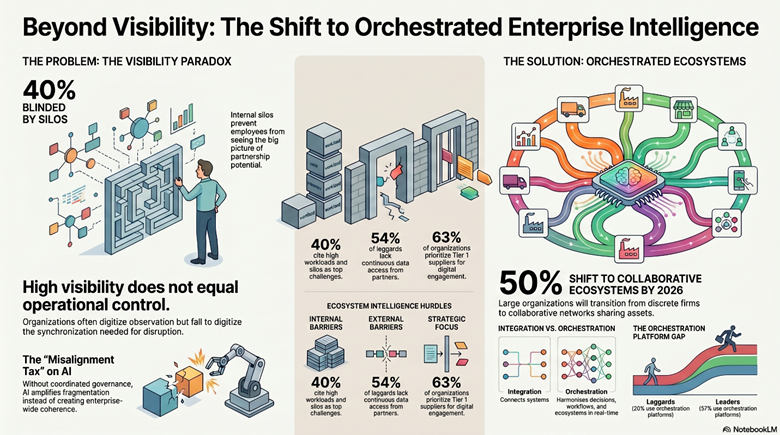
The Gartner Supply Chain Conference 2026 ultimately revealed something much larger than supply chain modernization. It revealed the early operational shape of the orchestrated enterprise. The organizations that succeed in the coming decade will likely not be distinguished merely by faster automation, larger AI investments, or more sophisticated dashboards. They will distinguish themselves through their ability to continuously synchronize decisions, orchestrate ecosystems, govern intelligence coherently, harmonize value delivery, and adapt dynamically to changing environments.
In that future, Enterprise Architecture does not become less relevant. It becomes more essential than ever — but also far more operational, adaptive, intelligence-driven, and ecosystem-centric than many organizations currently realize. Supply chain may simply be where the future is arriving first.