
By Steven Else Ph.D.
Executive Summary
The modern enterprise is shaped by five interdependent domains—products, data, supply chain, digital workplace, and applications—each explored in depth through Gartner’s conference ecosystem. While these events deliver powerful domain-specific insight, they are intentionally structured as parallel conversations aligned to distinct executive audiences. The result is clarity within domains, but limited integration across them. Enterprise and Solution Architecture provide the missing synthesis, connecting value creation, intelligence, execution, and—critically—experience into a coherent enterprise design.
This article introduces Enterprise Experience Architecture (EXA) as a necessary architectural layer that translates enterprise systems into usable, meaningful outcomes for both customers and employees. It is in this integration—beyond any single conference—that the future of enterprise architecture, and the integrated enterprise itself, truly emerges.
The integrated enterprise is not defined by any single capability, system, or strategy. It is defined by connection—by the way value is conceived, intelligence is generated, operations are executed, and, critically, how these are experienced by both customers and employees. What distinguishes leading organizations today is not the sophistication of any one domain, but the coherence with which these domains are translated into meaningful, usable, and consistent experiences. And yet, the conversations that shape enterprise transformation continue to unfold in parallel.
Few organizations have influenced those conversations more than Gartner. Through its research, advisory services, and global conferences, Gartner has created an ecosystem that helps enterprises interpret technological change with clarity and confidence. Its conferences provide a powerful vantage point into how different parts of the enterprise are evolving, bringing together product executives, data and analytics leaders, supply chain strategists, workplace innovators, and application architects—each exploring transformation through a focused lens.
In 2026, five such Gartner gatherings stand out: its Product Leadership Conference, Data & Analytics Summit, Supply Chain Symposium/Xpo, Digital Workplace Summit, and Application Innovation & Business Solutions Summit. Each is designed with precision. Each delivers depth. And each succeeds precisely because it maintains a clear boundary around its domain. Taken individually, these conferences provide actionable insight. Taken together, they reveal something more consequential: the structure of the modern enterprise as an interconnected system whose coherence is rarely addressed directly.
This is not a limitation of Gartner’s model so much as a reflection of its purpose. Its strength lies in decomposing complexity into domains that are meaningful for specific executive audiences. Product leaders focus on how value is defined and delivered. Data leaders concentrate on how value is understood and optimized. Supply chain leaders address how value is executed. Workplace leaders examine how people interact with systems. Application leaders focus on how systems are built and integrated.
This segmentation is both deliberate and effective. It enables clarity, relevance, and depth. It aligns with Gartner’s broader research and advisory model, where domain expertise is central to value creation and client engagement.
Yet the very effectiveness of this model introduces a structural constraint. By organizing conversations around domains, the enterprise itself is implicitly fragmented. The relationships between domains—where the most consequential architectural challenges reside—are not the primary focus of any single conversation. They emerge only when those conversations are viewed together. From an architectural perspective, those relationships are unmistakable.
The five conferences map to interdependent dimensions of enterprise operation. Product leadership defines how value is created. Data and analytics determine how that value is understood and optimized. Supply chain systems govern how value is executed and delivered. Application and solution architectures bring these elements into operational reality. And experience—spanning both customer and employee interaction—determines whether any of it is actually adopted and realized.
Experience as an Architectural Layer
While product, data, and execution systems define what the enterprise does, experience determines how that work is perceived, adopted, and sustained. It is the point at which architecture becomes real to the user.
This includes both customer experience and employee experience, which are increasingly intertwined through shared digital platforms, AI-driven interfaces, and workflow systems. The distinction between internal and external experience is fading; both are expressions of how effectively the enterprise translates its capabilities into human interaction.
From an architectural perspective, this suggests the emergence of a distinct layer—one that may be described as Enterprise Experience Architecture (EXA).
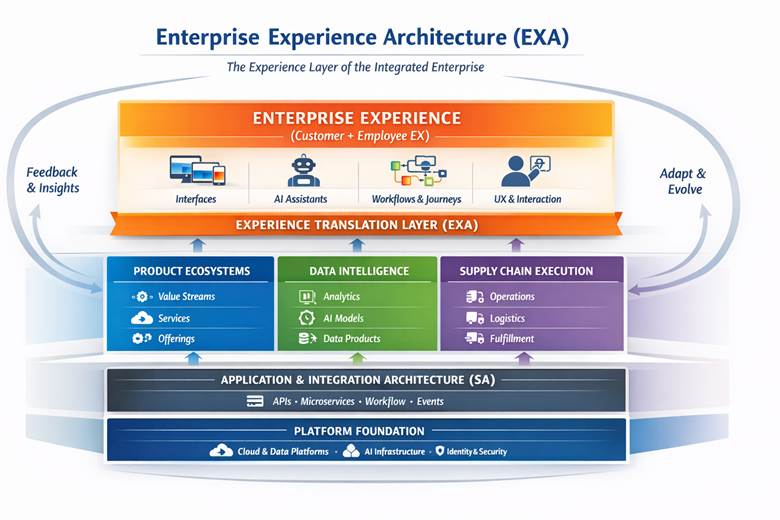
EXA represents an architectural discipline focused on designing the interaction layer between enterprise systems and the people who use them. It ensures that products, data, and operational systems are not only functional, but usable, intuitive, and aligned with real-world behaviors. It connects system design with human outcomes.
Without this layer, even well-designed systems remain underutilized. With it, architecture becomes visible, accessible, and impactful.
“Transformation rarely fails within domains—it fails between them, and most visibly at the point of experience. Architecture is the discipline that makes those connections usable, coherent, and real.”
Seen in isolation, each domain is powerful. Seen together, they form a system in which value gives rise to intelligence, intelligence informs execution, execution is mediated through experience, and all of it is realized through applications and platforms.
It is at the intersection of these dimensions that transformation either succeeds or breaks down.
A product strategy that does not account for data architecture will struggle to scale. A data initiative disconnected from execution will fail to deliver impact. A supply chain transformation that ignores application integration will introduce new inefficiencies. And an experience layer—whether customer-facing or employee-facing—that does not align with system design will limit adoption, regardless of how advanced the underlying technology may be.
Transformation, in practice, rarely fails within domains. It fails between them. This is the space in which enterprise architecture—and its close counterpart, solution architecture—becomes indispensable. Enterprise architecture provides the structural perspective that reveals how systems relate across the organization. Solution architecture translates that structure into executable systems. Together, they connect strategy to execution.
What is now required is an extension of that thinking—one that explicitly incorporates experience as a first-class architectural concern.
A New Imperative for Enterprise Design
Enterprises must be designed not as collections of capabilities, but as integrated systems that create value through products, generate intelligence through data, execute operations through supply chain systems, and translate all of this into coherent, usable experiences for customers and employees—realized through applications and platforms.
These systems must be continuously observed, analyzed, and evolved. Ultimately, it is through experience that architecture is judged—not by its internal elegance, but by its external impact.
The Architect’s Moment
This synthesis elevates the role of the architect. Architects are no longer simply designers of systems or enforcers of standards. They are integrators of enterprise domains, interpreters of complexity, and designers of adaptive systems—responsible not only for how systems function, but for how they are experienced. Their work lies not at the center of any one conversation, but at the intersection of all of them.
Conclusion
Gartner’s conference ecosystem offers one of the most comprehensive views available of how modern enterprises are evolving. Each event provides valuable insight into a critical domain of transformation. But the full significance of these insights emerges only when they are connected—and when those connections are translated into experience.
Enterprise Architecture, Solution Architecture, and now Enterprise Experience Architecture provide the means to make those connections real. Gartner provides the conversations.
Architecture connects them. Experience validates them. And it is in that integration that the future of enterprise design will be shaped.