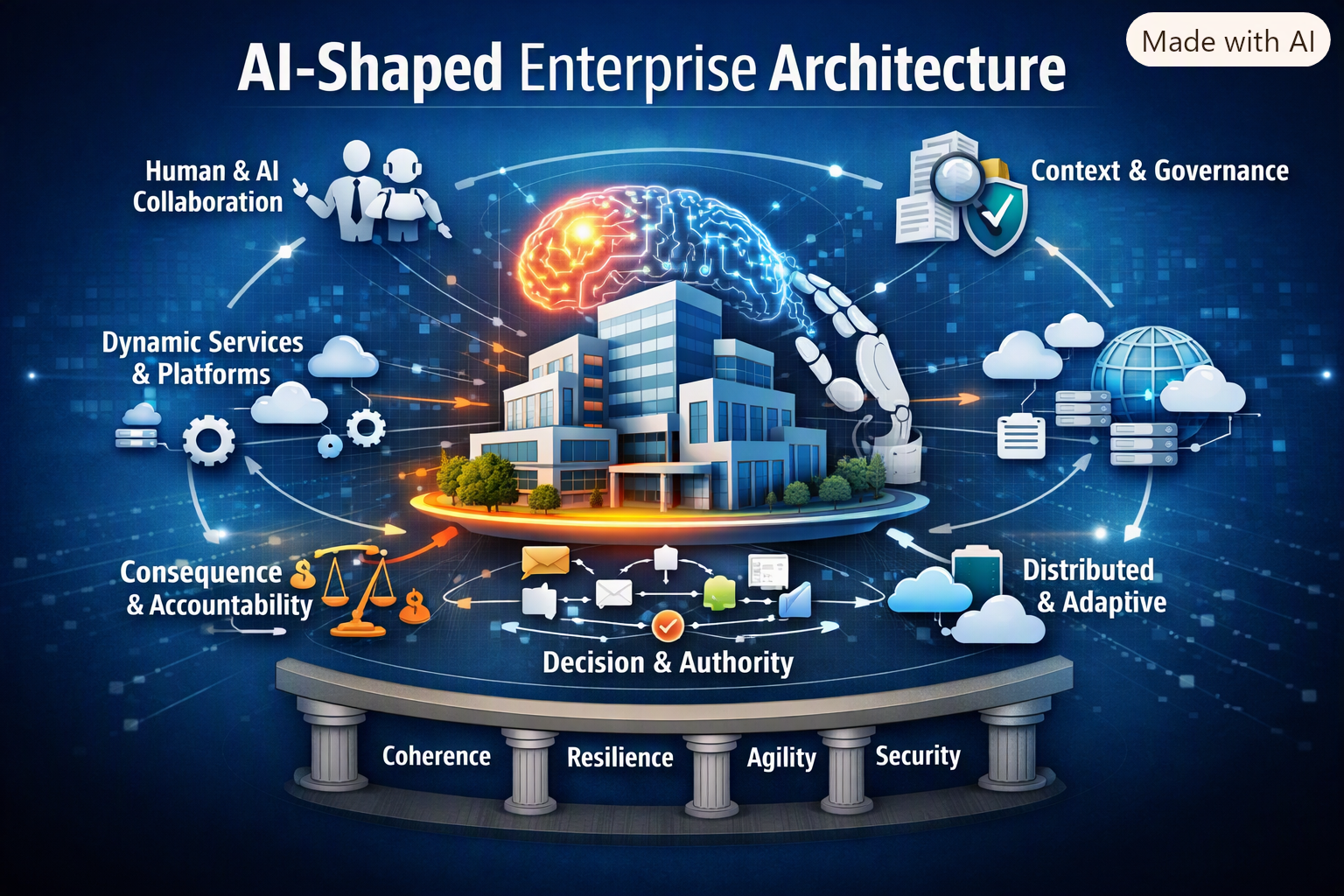
Gartner’s IT Symposium/Xpo 2026 made one thing unmistakably clear: artificial intelligence is reshaping enterprises faster than their operating structures, governance mechanisms, and technology architectures were ever designed to accommodate. Across sessions on agentic systems, AI context platforms, distributed cloud, operating‑model redesign, sovereign technology, and disposable applications, a deeper pattern came into focus.
Enterprises do not experience these developments as isolated trends. They experience them as one enterprise. And that raises the defining architectural question of the coming decade: How can organizations preserve enterprise coherence while intelligence, autonomy, applications, work, information, economics, and governance all change at once?
Answering that question requires more than another technology strategy. It demands an architectural ability to see—and shape—the whole.
Integrale Architecture™: A Foundation for Coherence
Integrale Architecture™, the approach I have been developing, is designed precisely for this challenge. It moves beyond integration and interoperability to ask a more demanding question: Does the combined arrangement make enterprise sense?
Rather than examining isolated domains, Integrale Architecture™ looks across purpose, value, capabilities, people, artificial actors, knowledge, context, decisions, authority, autonomy, processes, technology, economics, governance, risk, execution, evidence, and adaptation. Its aim is coherence—ensuring that individually rational decisions do not collectively produce an incoherent enterprise. With this foundation, we can interpret what Symposium/Xpo 2026 reveals about the emerging architecture of the AI‑shaped enterprise.
Beyond AI ROI: The Larger Architectural Shift
My earlier article explored Gartner’s finding that CEOs struggle to demonstrate meaningful financial returns from AI. Symposium/Xpo reinforced that point, but also made clear that AI ROI is only one symptom of a much broader architectural transformation.
As AI becomes embedded in enterprise operations, leaders must confront questions that cut across traditional boundaries:
- Who—or what—is authorized to make a decision?
- What context may an AI agent use?
- Which applications matter when software becomes disposable?
- Where does accountability reside when humans and autonomous agents collaborate?
- How can organizations govern AI without destroying the speed that makes it valuable?
- How should economic, security, workforce, and technology decisions connect?
These questions form an interconnected system. Organizations can make sensible decisions in each area and still produce an incoherent enterprise.
A Constellation of New Architectural Elements
Symposium/XPo 2026 showcased a set of emerging themes that collectively describe the architecture of a different kind of enterprise:
- AI context platforms
- Agent identity and privilege control
- Human–agent operating‑model redesign
- Disposable applications
- Sovereign technology and provider optionality
- Agentic governance and guardrails
- AI economics and sustainability
- Distributed cloud and AI architectures
Each domain can be assigned to a specialist. The difficulty is that their answers interact—and sometimes collide. Agent autonomy affects security. Security affects operating‑model flexibility. Operating models affect economics. Economics influence technology choices. Technology choices shape provider dependence. Provider dependence affects resilience. Context quality affects agent decisions. Agent decisions affect customers, finances, regulatory exposure, and reputation. Specialist excellence does not guarantee enterprise coherence.
From Applications to Actors
For decades, enterprise architecture has centered on applications. Symposium/XPo made clear that agentic AI disrupts that model. AI agents increasingly behave as enterprise participants—interpreting information, invoking services, initiating workflows, and sometimes acting autonomously. The architectural center of gravity shifts from:
People using applications → Human and artificial actors operating through dynamic collections of services, models, information, and platforms.
This introduces new relationships:
Actor → Role → Context → Decision → Authority → Action → Consequence
And it reinforces a foundational principle: Intelligence does not imply authority.
Architects must help organizations define:
- Delegable decisions
- Degrees of autonomy
- Mandatory human approvals
- Contextual conditions that alter authority
- Evidence requirements
- Revocation mechanisms
- Accountability boundaries
These are architectural relationships—not merely technical ones.
Context Architecture: The Next Frontier
Symposium/XPo highlighted a shift from data architecture to context architecture. Data describes facts. Context explains what those facts mean in a situation.An autonomous procurement agent may have excellent supplier data yet make a poor decision if it lacks geopolitical awareness, contractual nuance, policy exceptions, or executive intent. This introduces a broader progression:
Data → Information → Knowledge → Context → Judgment → Decision → Action
Much of enterprise knowledge lives outside structured databases—in policies, documents, conversations, histories, and human expertise. AI context platforms may expose more of this to intelligent systems, but architects must determine:
- What context matters
- Who governs it
- How quality is assessed
- How current it is
- Who may use it
- How it influences decisions
This is the intersection of EA, Knowledge Management, semantics, AI engineering, governance, and organizational judgment.
The Architecture of Consequence
Symposium/XPo repeatedly emphasized that the AI‑shaped enterprise requires architects to understand consequences, not just structures. An AI agent accesses information → interprets it → reaches a conclusion → triggers a workflow → produces financial, legal, regulatory, reputational, or human effects.
A technically correct model may be strategically incomplete. The more important question becomes: What happens because these things interact?
This is where Systems Engineering and MBSE become essential. Enterprise Architecture must increasingly operate at the scale of system behavior, not just system structure.
Disposable Applications, Durable Architecture
Discussions on disposable applications underscored a major shift: if software becomes short‑lived—created rapidly by humans or AI, used for months, then discarded—traditional governance cannot review every implementation. Architecture must move upward. The durable elements become:
- Capabilities
- Enterprise semantics
- Authoritative information
- Policies
- Decision rights
- Identities
- Services
- Interfaces
- Security boundaries
- Guardrails
- Context
- Outcomes
Applications become temporary implementations inside persistent architectural boundaries. EA shifts from governing implementations to governing the conditions within which implementations may safely emerge, operate, evolve, and disappear.
The Distributed Enterprise
Symposium/XPo highlighted the increasing distribution of enterprise architecture:
- Models in one environment
- Data in another
- Inference elsewhere
- Agents across platforms
- Services from multiple providers
- Identity governed externally
- Accountability held by humans far from the infrastructure
Distribution magnifies the need for coherence across environments. A technically elegant architecture inside one platform may produce enterprise problems when combined with decisions made elsewhere.
Specialist Excellence Is Not Enterprise Coherence
Enterprises already possess deep expertise—EA, solution architecture, security, data, cloud, SAP, AI engineering, Systems Engineering, Knowledge Management, finance, HR, risk, vendors, consultants. The problem is not insufficient expertise. It is that individually excellent advice may not add up to an excellent enterprise. This is the renewed purpose of Enterprise Architecture: ensuring specialist excellence produces enterprise coherence rather than enterprise fragmentation.
The Rise of the Trusted Architecture Advisor
Executive discussions at Symposium/XPo revealed a growing need for a new role: the Trusted Architecture Advisor.
Large organizations do not lack experts. They lack synthesis. The Trusted Architecture Advisor helps leadership understand how all the expertise fits together—identifying tensions, dependencies, assumptions, second‑order consequences, and the true nature of the decision being made. The advisor does not replace specialists. The advisor connects them. This role requires breadth, depth, systems understanding, architectural judgment, organizational awareness, and executive communication skill.
Architecture Requires More Than Modeling
Framework fluency, modeling competence, and technology knowledge remain useful but are no longer sufficient. Architectural leadership now requires:
- Systems thinking
- Executive judgment
- MBSE rigor without mechanistic reduction
- Knowledge Management
- Economic understanding
- Storytelling that makes complexity actionable
Architects must translate:
complexity → meaning → alternatives → decisions → coherent action
Conclusion: Who Is Architecting the Enterprise AI Is Creating?
Symposium/Xpo 2026 made clear that the first wave of enterprise AI focused on capability. The next wave focuses on consequence.
Who may act? Who remains accountable? What context should intelligent systems use? What stays permanent when applications become temporary? How should work be redesigned? How should authority be divided? How should resilience be preserved across distributed models, data, platforms, and agents? How can leaders detect when individually rational decisions produce collective incoherence?
The answers will come from many disciplines. No single specialist will own them. The enterprise needs architects who respect specialist depth while seeing across boundaries. It needs advisers who can connect systems, knowledge, economics, technology, organizational realities, and human judgment. Enterprise Architecture must help assemble the whole. And the most important architectural question of the AI era may also be the simplest:
Who is architecting the enterprise that AI is creating?