
When Technology Moves Faster Than Ecosystems: An Architectural Framework for Digital Transformation
by Prabhakar V.
Introduction
Despite sustained global investment in digital transformation, improvements in digital capability have not consistently translated into better execution performance, and the gap is measurable across more than one sector. Siemens’ True Cost of Downtime study found that unplanned downtime cost the world’s 500 largest companies $1.4 trillion in 2024 — 11% of their combined revenue, up from $864 billion (8% of revenue) in 2019–20, a period in which most of these companies substantially increased their investment in digital monitoring and predictive-maintenance technology (Siemens, 2024). In the automotive industry specifically, global passenger car OEMs paid a total of $57.9 billion in warranty claims in 2024, the second consecutive record year despite widespread adoption of advanced digital manufacturing and connected technologies (Warranty Week, 2025). In both cases the comparison is temporal and sector-specific: execution costs rose over a period in which the underlying digital capability of the same companies was demonstrably increasing, which is the core puzzle this paper addresses.
This paradox reveals a fundamental architectural challenge. Enterprises continue to design digital transformation assuming that suppliers, partners, workforce capabilities, logistics networks, and infrastructure evolve at comparable rates. In reality, these ecosystem components mature asynchronously, creating structural mismatches between digital capability and execution capacity. The result is an architectural gap in which technology advances faster than the ecosystems required to realize its value.
The Architectural Reality: Multi-Tier Maturity Topologies
Traditional digital transformation architectures assume a relatively homogeneous ecosystem in which partners, suppliers, and service providers operate at comparable levels of digital capability with standardized interfaces and synchronized evolution. This assumption influences platform design, integration patterns, automation logic, and orchestration models.
In practice, ecosystems exhibit significant variation in digital maturity. Small and medium-sized enterprises (SMEs) account for the large majority of businesses worldwide and a substantial share of global employment, yet they continue to lag behind large enterprises in digital adoption (World Bank, 2023; OECD, 2024). Within the European Union, Eurostat’s 2024 Digital Intensity Index shows that while 73% of EU SMEs had reached at least a basic level of digital intensity, only around 24% reached a high or very high level, compared with 98% of large enterprises reaching at least a basic level (European Commission/Eurostat, 2024). This disparity creates a multi-tier ecosystem in which organizations operate with fundamentally different levels of digital capability.
Tier 1 (Advanced layer): Large manufacturers and global enterprises operating cloud-native platforms, enterprise-wide ERP, advanced analytics, real-time integration, and automated decision support. Although these organizations represent a relatively small proportion of ecosystem participants (typically 15–20% by organization count), they account for a significant share of economic output and often define the digital architecture adopted across the value chain.
Tier 2 (Intermediate layer): Medium-sized organizations with partial digital adoption, including ERP systems, limited API integration, and semi-automated business processes. These organizations typically represent 30–35% of ecosystem participants by organization count, serving as the bridge between highly digital enterprises and less mature suppliers.
Tier 3 (Manual or legacy layer): SMEs relying on spreadsheets, email-based coordination, manual workflows, and limited system integration. This group represents approximately 50–60% of ecosystem participants by organization count and performs critical execution activities such as component supply, subassembly manufacturing, specialized processing, and logistics (World Bank, 2023; OECD, 2024).
The architectural challenge is not the existence of these maturity differences, but the assumption that a digitally advanced enterprise can achieve end-to-end execution through an ecosystem that operates at substantially different levels of capability. In effect, many organizations architect for Tier 1 digital maturity while depending on Tier 2 and Tier 3 ecosystems for execution, creating structural bottlenecks that technology alone cannot eliminate.
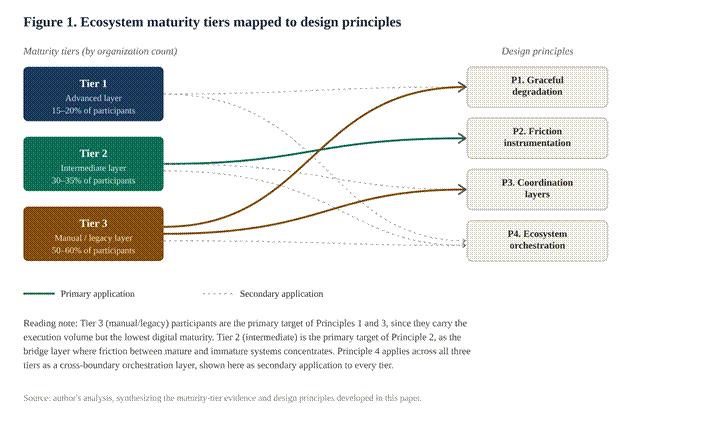
Figure 1. Conceptual Enterprise Architecture framework showing the relationship between ecosystem maturity tiers and architectural design principles.
Architectural Mismatch: When Intelligence Layers Cannot Execute
Manufacturing ecosystems illustrate how architectural assumptions break down under asynchronous maturity conditions. Large manufacturers deploy IoT, digital twins, predictive maintenance, and real-time production monitoring to improve decision-making across multi-tier supply networks (Deloitte, 2024). These capabilities assume an equally mature execution ecosystem with digitally integrated suppliers, synchronized planning, and responsive logistics.
In practice, this assumption rarely holds. McKinsey’s Global Supply Chain Leader Survey has found that visibility into supply chain tiers beyond direct (Tier-1) suppliers has declined for two consecutive years, even as the majority of large enterprises maintain highly integrated internal supply chain platforms (McKinsey & Company, 2024). The decision architecture functions as intended; the execution architecture operates at a lower level of maturity.
The impact is measurable. A quality issue detected in real time may still take days or weeks to resolve if upstream suppliers rely on manual planning or spreadsheet-based processes. This disconnect increases lead times, inventory buffers, warranty costs, and service delays despite sophisticated enterprise systems.
The visibility gap has a specific structural shape, and it explains why the McKinsey finding above matters in practice. Manufacturers routinely track their own stock levels and their immediate suppliers well. What falls outside that view is everything one or more steps removed: a Tier-2 supplier’s inventory quietly running down, a process parameter drifting out of specification somewhere upstream, or a customer’s own stock accumulating as their order rate slows. Each of those conditions precedes a disruption by days or weeks, but because none of them sit inside the OEM’s normal field of view, the first signal most manufacturers actually receive is the disruption itself at which point production is already committed and the range of available responses has narrowed considerably (Andersen, 2026). A second, separate problem sits on top of the first: seeing a problem earlier is not the same as being able to do anything about it. An organization can build extensive upstream monitoring and still fail here if no one downstream of the alert has both the authority and the process to act on it in which case the monitoring has added information without adding resilience (Andersen, 2026).
Case: the 2021 automotive semiconductor shortage
The global semiconductor shortage of 2021 is a documented, quantified instance of the Tier 1/Tier 2/Tier 3 mismatch described above, and illustrates why intelligence-layer sophistication does not guarantee execution-layer performance. Automotive-grade chips are supplied through a deep chain: OEMs contract with Tier-1 systems suppliers, who source chips from Tier-2 specialty semiconductor producers, who in turn depend on a small number of Tier-3 foundries — for whom automotive orders are a minor share of a much larger, non-automotive order book (Gartner, cited in Critical Manufacturing, 2021). Because visibility and forecasting stop at Tier-1 for most OEMs, the industry had almost no advance warning when foundry capacity was reallocated toward consumer electronics during 2020.
Toyota was the partial exception. Following the 2011 Tōhoku earthquake, Toyota had rebuilt its supplier architecture specifically to extend visibility and buffer-stock coordination down to Tier-3 and Tier-4 suppliers. That architectural investment meant Toyota could see the semiconductor constraint earlier and stockpile critical parts; while Ford and General Motors idled North American plants in the first half of 2021, Toyota initially raised its 2021 production forecast to 9.6 million vehicles, roughly 6% above the prior year (SupplyChainBrain, 2021). The advantage was not durable, however: by September 2021, new outbreak-driven shutdowns among Southeast Asian sub-tier suppliers reached even Toyota’s deeper visibility, and the company cut its full-year production forecast by 40%, equivalent to 330,000 fewer vehicles (Supply Chain Dive, 2021). Industry-wide, AlixPartners’ revenue-loss estimate for the shortage rose from $110 billion in May 2021 to $210 billion by September 2021, alongside a forecast of 7.7 million lost vehicles for the year (AlixPartners, 2021).
The case demonstrates the paper’s central claim with concrete figures rather than illustration alone: deeper ecosystem visibility measurably delayed the point of failure (Toyota held out roughly two quarters longer than peers with shallower supplier architecture), but it did not eliminate the failure, because the underlying execution layer — Tier-3 and Tier-4 foundry capacity, located outside any single OEM’s control — could not be reshaped on the same timescale as the intelligence layer that detected the problem. This is consistent with survey evidence that visibility drops sharply below Tier-1: even after the shortage, a large share of automotive firms report very limited visibility into Tier-3 suppliers, and most chief procurement officers report tracking risk no deeper than their immediate suppliers (Deloitte, cited in Approved Forwarders, 2021).
The workforce reflects the same mismatch. Deloitte and The Manufacturing Institute’s ongoing research on the U.S. manufacturing skills gap estimates that as many as 1.9 million manufacturing jobs could remain unfilled by 2033 — a figure revised down from an earlier 2.1-million-by-2030 projection, but still substantial (Deloitte & The Manufacturing Institute, 2024). At the same time, the World Economic Forum’s Future of Jobs Report 2025 found that employers expect 39% of workers’ core skills to change by 2030, down from 44% in the 2023 edition — a moderating trend, but one that still implies a large and continuous retraining burden (World Economic Forum, 2025). Technology evolves in months; workforce capability evolves over years. The result is structural latency: enterprise systems know what needs to happen long before the ecosystem can execute.
From an Enterprise Architecture perspective, the challenge is not technology but architectural alignment. Digital transformation succeeds only when decision architecture and execution architecture evolve together across the entire ecosystem.
Supply Chain Architecture: Brittle Integration Patterns
The typical manufacturing supply chain architecture follows a hub-and-spoke integration pattern: the OEM maintains direct digital connections with Tier-1 strategic suppliers (the spokes), while Tier-2 and Tier-3 connections rely on manual data exchange, periodic batch updates, or intermediary platforms. This creates architectural blind spots where visibility degrades with distance from the hub.
Post-pandemic disruptions exposed this architectural weakness. Even highly digitized manufacturers experienced cascading failures not because their systems failed, but because their assumed architectural topology (integrated, visible, responsive) did not match the actual topology (fragmented, opaque, asynchronous).
A semiconductor shortage that began at Tier-3 chemical suppliers took weeks to surface in Tier-1 planning systems. Quality issues detected through AI-enabled inspection could not be traced to root causes because Tier-2 process data existed only in paper logs. Production optimization algorithms recommended schedule changes that Tier-3 suppliers lacked the digital infrastructure to accommodate.
The architectural implication: ecosystem architecture must be designed for partial observability and degraded execution modes, not assumed full visibility and synchronized response.
Workforce and Infrastructure Architecture: The Multi-Speed Challenge
Organizational learning architectures i.e. certification programs, training systems, and knowledge transfer mechanisms — operate on fundamentally different cycles than technology deployment architectures. This creates a temporal architecture mismatch, illustrated in Figure 2, in which three layers evolve on non-overlapping timescales.
Technology deployment layer: Continuous integration, monthly releases, real-time updates. Measured in days to months.
Capability development layer: Certification programs (12–24 months), apprenticeships (2–4 years), institutional knowledge transfer (3–5 years). Measured in years.
Infrastructure investment layer: Manufacturing facilities, logistics networks, testing laboratories, regulatory frameworks. Measured in decades.
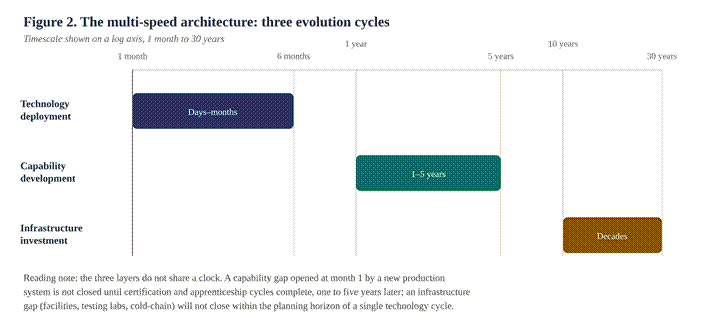
Figure 2. Relative evolution speeds of technology, organizational capability, and infrastructure, illustrating the temporal mismatch that creates asynchronous ecosystem maturity.
Germany illustrates the pattern. As of 2025, the Federal Employment Agency (Bundesagentur für Arbeit) identified critical shortages across 163 occupations, concentrated in engineering, skilled trades, and other technical roles; independent estimates from the Institute for Employment Research (IAB) and the German Economic Institute (IW) put unfilled positions in the top shortage sectors at over 260,000 (Bundesagentur für Arbeit, 2025). In the United States, the National Association of Manufacturers’ quarterly outlook surveys have consistently identified attracting and retaining talent as manufacturers’ primary business challenge. The pattern in both economies is the same: innovation velocity exceeds capability regeneration rate.
Infrastructure presents an additional layer of temporal mismatch. Gaps in cold-chain infrastructure, testing facilities, and quality certification systems persist across global trade corridors even as product complexity and regulatory requirements evolve on annual cycles. This infrastructure requires decade-long investment cycles to develop.
Effective ecosystem architecture must account for this multi-speed topology rather than assuming synchronized evolution across all layers.
Designing for Architectural Resilience: Four Principles
If asynchronous maturity is a structural condition rather than a temporary state, ecosystem architecture requires different design principles. Figure 1 maps each principle to the tier where it applies most directly: Principles 1 and 3 are aimed primarily at Tier 3 participants, who carry the majority of execution volume at the lowest digital maturity; Principle 2 is aimed primarily at Tier 2, the bridge layer where friction between mature and immature systems concentrates; and Principle 4 applies across all three tiers as a cross-boundary orchestration layer. The sequence below follows that same order i.e. an organization applying this framework would typically start by auditing its own tier distribution, then prioritize Principles 1 and 3 where Tier 3 dependence is highest, Principle 2 where Tier 2 friction is highest, and Principle 4 throughout.
Principle 1: Design for graceful degradation, not uniform capability
Digital architectures typically assume binary states: integrated or not integrated, automated or manual. Resilient ecosystem architecture requires graduated capability assumptions — systems that function effectively even when partners operate at lower maturity levels.
This means building tolerance for incomplete data (systems continue functioning with partial data availability rather than failing below a high completeness threshold), manual fallback pathways (human override and intervention points at critical junctions), and adaptive workflows (process logic that adjusts based on partner capability levels rather than assuming uniform digital readiness).
Advanced manufacturers implementing demand-driven material resource planning (DDMRP) demonstrate this principle by maintaining buffer inventories specifically to accommodate supplier variability, an architectural recognition that perfect visibility and synchronization across all tiers is unachievable.
Principle 2: Instrument for friction, not just flow
Traditional architecture monitoring focuses on throughput, cycle time, and defect rates — metrics that assume systems operate as designed. Ecosystem architecture should instrument for structural friction: exception rates, manual override frequency, coordination delays, escalation patterns, and data completeness gaps.
These friction metrics serve as early warning indicators of ecosystem capability constraints. When exception rates rise, it signals not system failure but architectural mismatch between what the technology enables and what the ecosystem can execute. Manufacturing leaders monitoring these patterns can identify capability gaps before they manifest as production delays or cost overruns.
Instrumentation on its own does not close the gap, though. If a friction metric reaches a report or a screen but never reaches a person with the authority to change something, the organization has spent effort generating data rather than resilience, the same architectural failure still occurs, just with better documentation of why (Andersen, 2026). The more durable design practice is to specify the response before building the metric: name who is alerted, what action they are authorized to take, and how quickly, at the point the instrumentation is designed rather than after it has already started generating alerts nobody owns.
Principle 3: Build coordination layers, not just integration layers
Most digital transformation architecture emphasizes data integration: APIs, data lakes, and real-time synchronization. Asynchronous ecosystems require coordination architecture: shared standards, interoperability frameworks, and capability development mechanisms.
Germany’s Plattform Industrie 4.0 brings together more than 350 stakeholders from over 150 organizations, spanning government, industry, and research to develop common data models, reference architectures, and interoperability standards. This coordination layer reduces bilateral integration complexity and enables broader SME participation in digital manufacturing ecosystems (Plattform Industrie 4.0, 2024).
Singapore’s SMEs Go Digital programme, led by the Infocomm Media Development Authority (IMDA), has supported more than 80,000 SMEs through digital capability assessments, training, grants, and platform access since its 2017 launch. Rather than requiring full digital transformation, it provides the capability scaffolding that enables lower-maturity organizations to participate effectively in digitally integrated ecosystems (IMDA, 2024).
Principle 4: Design for ecosystem orchestration, not enterprise optimization
Traditional architecture optimizes within organizational boundaries: minimizing internal costs and maximizing internal efficiency. Ecosystem architecture requires cross-boundary orchestration: designing for collective capability rather than individual performance.
Industry surveys of logistics and supply chain executives consistently identify physical infrastructure i.e. warehousing, logistics hubs, and last-mile capacity alongside digital platforms as a top investment priority. This reflects recognition that physical execution architecture must evolve alongside digital platform architecture. Manufacturing ecosystems cannot be purely digital solutions when they depend on physical flows, human expertise, and infrastructure that evolves on different timescales.
From Architectural Vision to Executable Reality
The Fourth Industrial Revolution is frequently framed as a race toward technological sophistication. In practice, it is an exercise in architectural realism that requires designing systems capable of operating effectively across ecosystems with heterogeneous digital maturity rather than assuming uniform capability.
The 2021 semiconductor shortage, discussed above, illustrates this challenge with measurable outcomes rather than illustration alone. Toyota’s investment in deeper supplier-tier visibility bought the company roughly two additional quarters of resilience relative to peers, a real and quantifiable architectural advantage, but it could not resolve a constraint that originated at Tier-3 and Tier-4, several architectural layers beyond where even an advanced OEM’s coordination reach could extend. The intelligence layer succeeded in generating an earlier warning; the execution layer, distributed across suppliers several tiers removed from direct influence, still could not respond on the same timescale.
Competitive advantage will increasingly depend on architectural adaptability: the ability to design platforms, processes, and partnerships that operate effectively across multiple maturity levels while accommodating different capability and investment cycles.
This requires Enterprise Architecture to extend beyond organizational boundaries to ecosystem architecture, in which suppliers, partners, workforce capability, logistics, and infrastructure are treated as integral architectural components rather than external dependencies.
By architecting for asynchronous maturity, building coordination mechanisms alongside integration capabilities, and designing for heterogeneous execution environments, organizations can translate digital transformation into sustained operational performance rather than isolated technological advancement.
References
AlixPartners. (2021, September 23). Shortages related to semiconductors to cost the auto industry $210 billion in revenues this year [Press release]. https://www.alixpartners.com/newsroom/press-release-shortages-related-to-semiconductors-to-cost-the-auto-industry-210-billion-in-revenues-this-year-says-new-alixpartners-forecast/
Andersen, N. (2026, July 16). 5 reasons your intelligent supply network will fail. LNS Research Blog. https://blog.lnsresearch.com/5-reasons-your-intelligent-supply-network-will-fail
Bundesagentur für Arbeit. (2025, May 28). Qualified skilled workers urgently required: Shortages in 163 occupations [Press release]. Federal Employment Agency of Germany. https://www.arbeitsagentur.de/en/press/2025-25-qualified-skilled-workers-urgently-required-shortages-in-163-occupations
Critical Manufacturing. (2021). Global semiconductor shortage: A hard-learnt lesson for the automotive industry. https://www.criticalmanufacturing.com/blog/global-semiconductor-shortage-a-hard-learnt-lesson-in-supply-chain-visibility-and-collaboration/
Deloitte. (2024). 2024 manufacturing industry outlook. Deloitte Insights.
Deloitte & The Manufacturing Institute. (2024). US manufacturing could need as many as 3.8 million new employees by 2033 [Press release]. https://www2.deloitte.com/us/en/pages/about-deloitte/articles/press-releases/us-manufacturing-could-need-new-employees-by-2033.html
European Commission / Eurostat. (2024). How digitalised have the EU’s enterprises become? Eurostat Digital Economy and Society Statistics. https://ec.europa.eu/eurostat/web/products-eurostat-news/w/ddn-20240829-1
Infocomm Media Development Authority (IMDA). (2024). SMEs Go Digital programme factsheet. https://www.imda.gov.sg
McKinsey & Company. (2024). Taking the pulse of shifting supply chains. McKinsey Global Supply Chain Leader Survey.
OECD. (2024). SME and entrepreneurship outlook. OECD Publishing.
Plattform Industrie 4.0. (2024). The platform: Background and structure. https://www.plattform-i40.de
Siemens. (2024). The true cost of downtime 2024.
Supply Chain Dive. (2021, September 14). Shutdowns in Asia sting Toyota, automakers and exacerbate chip shortage. https://www.supplychaindive.com/news/toyota-cuts-production-due-to-chip-shortages/606487/
SupplyChainBrain. (2021, June 3). Three key lessons from the chip shortage crisis. https://www.supplychainbrain.com/blogs/1-think-tank/post/33204-three-key-lessons-from-the-chip-shortage-crisis
Warranty Week. (2025, October 30). Worldwide auto warranty report. https://www.warrantyweek.com/archive/ww20251030.html
World Bank. (2023). Small and medium enterprises (SMEs) finance. World Bank Group.
World Economic Forum. (2025). The future of jobs report 2025. https://www.weforum.org/publications/the-future-of-jobs-report-2025/
About the Author
Prabhakar V. is a digital transformation leader with over two decades of experience across the automotive, sustainable energy, chemical, and HVAC industries. Currently associated with Tata Technologies, he has delivered transformative digital initiatives across the value chain, collaborating with global organizations on complex IT and digital programs in process optimization, smart manufacturing, and automation. Drawing on Industry 4.0 principles, he works with teams and organizations to translate digital transformation into measurable operational performance.