
By Steve Else, Ph.D.
Executive Summary
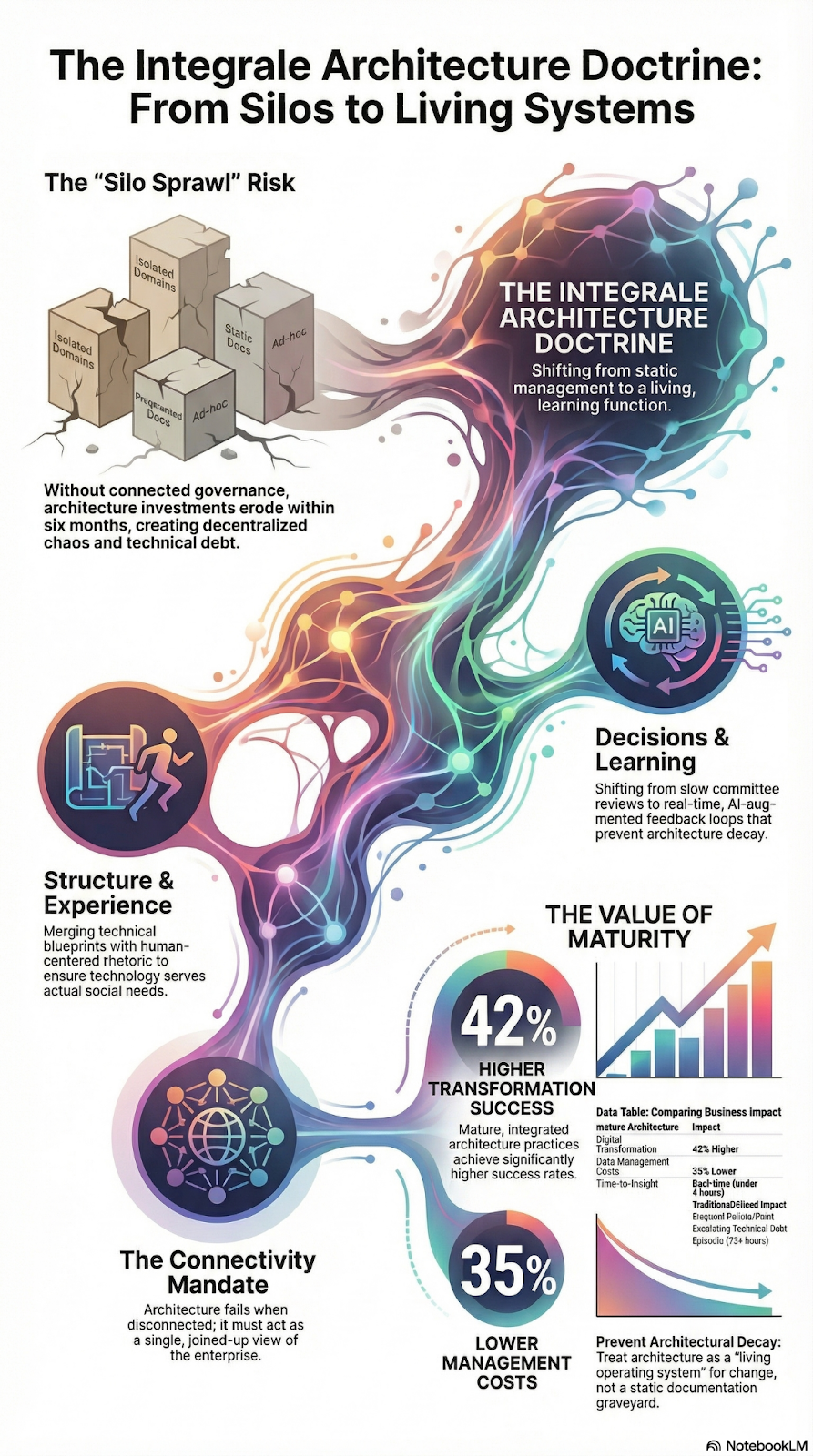
Enterprise Architecture is at an inflection point. Traditional approaches, while foundational, are no longer sufficient to address the scale, speed, and interconnected complexity of modern enterprises. This article presents a unified architectural doctrine built on four interdependent elements: Integrale Architecture (IA), Enterprise Experience Architecture (EXA), the Cohistic Governance Framework (CGF), and the Continuous Architecture Intelligence Loop (CAIL).
Together, these form a living system—one that connects enterprise domains, translates them into experience, governs decisions coherently, and continuously learns from execution. This integrated model reframes architecture not as a static discipline of design, but as a dynamic capability of connection, realization, and evolution. Modern enterprises are no longer defined by their individual capabilities. They are defined by how those capabilities interact.
Organizations have invested heavily in product innovation, data platforms, supply chain optimization, digital workplace technologies, and application modernization. Each of these domains has matured, supported by specialized leadership and deep expertise. Yet the outcomes of transformation efforts remain uneven. Initiatives succeed in isolation but struggle to scale across the enterprise. Systems are built, but not fully adopted. Decisions are made, but not consistently aligned. The issue is not a lack of capability. It is a lack of integration.
What is required is a shift in perspective—from viewing the enterprise as a collection of domains to understanding it as a system of systems. This is the foundation of Integrale Architecture (IA).
Integrale Architecture connects the core dimensions of the enterprise—product, data, supply chain, and experience—into a unified structure. Product defines value. Data provides intelligence. Supply chain executes operations. Experience determines how those capabilities are perceived, adopted, and sustained. These elements are not independent layers. They are interdependent parts of a single system whose effectiveness depends on their coherence.
This perspective immediately reveals a critical insight: architecture is not complete until it is experienced. This is the role of Enterprise Experience Architecture (EXA).
EXA elevates experience from a design concern to an architectural layer. It ensures that enterprise systems—no matter how well designed—are translated into interactions that are intuitive, coherent, and aligned with real-world behavior. It connects backend capability with human engagement, bridging the gap between system intent and user reality. Without EXA, architecture remains abstract.\ With it, architecture becomes visible and actionable. Yet structure and experience alone are not sufficient. The enterprise must also make decisions—continuously, and across domains.
This is where many architecture efforts falter. Governance exists, but it is often external, episodic, and focused on compliance rather than decision quality. To address this, the Cohistic Governance Framework (CGF) reframes governance as an embedded, decision-centric capability.
CGF ensures that the enterprise operates coherently by focusing on how decisions are made, aligned, and evolved. It introduces a cognitive dimension to governance, treating it not as oversight, but as the system’s ability to think—collectively and continuously. Through attributes such as coherence, coordination, collaboration, and convergence, governance becomes a mechanism for alignment rather than constraint.
This cognitive capability is reinforced through traceability and learning, which brings us to the fourth element of the model: the Continuous Architecture Intelligence Loop (CAIL).
CAIL transforms architecture into a learning system. It captures insights from implementation, operations, and experience, synthesizes those insights into actionable intelligence, and feeds them back into architecture and governance. In doing so, it ensures that architecture is not fixed, but continuously refined. Decisions improve over time. Patterns evolve. The enterprise adapts.
Taken together, these four elements form a complete system:
- Integrale Architecture (IA) connects the enterprise
- Enterprise Experience Architecture (EXA) ensures it is usable and adopted
- Cohistic Governance Framework (CGF) aligns decisions across domains
- Continuous Architecture Intelligence Loop (CAIL) enables continuous learning and improvement
This system can be understood as a cycle:
- Structure enables capability.
- Capability is realized through systems.
- Systems are validated through experience.
- Experience generates insight.
- Insight refines decisions.
- Decisions reshape structure.
In this cycle, architecture is no longer a static blueprint. It is a living system. This has important implications for how architecture is practiced. Architects are no longer confined to designing structures or enforcing standards. They become integrators of domains, stewards of coherence, and curators of architectural intelligence. Their work spans not only systems, but decisions and experiences.
Similarly, governance evolves from a control function into a cognitive capability. It becomes embedded in the flow of work, enabling better decisions rather than constraining them. And feedback, rather than being incidental, becomes central—driving continuous improvement through CAIL. The result is an enterprise that is not only integrated, but adaptive. It is capable of responding to change, aligning across domains, and improving over time without requiring constant reinvention. This is the essence of Integrale Architecture as a living system.
It is not a replacement for existing frameworks, but an evolution—one that reflects the realities of modern enterprises. It builds upon established practices while extending them to address integration, experience, governance, and learning as a unified whole. In doing so, it offers a new way to think about architecture: Not as a discipline of isolated design, but as a system of connection, realization, and continuous evolution.
Final Thought
Architecture is no longer something we design once. It is something we connect, govern, experience, and continuously learn.