
Why the Future of Supply Chain Is Enterprise Intelligence
For more than a decade, visibility has been one of the defining promises of digital supply chain transformation. Organizations invested heavily in dashboards, tracking systems, monitoring platforms, control towers, analytics engines, and increasingly sophisticated reporting capabilities with the belief that greater visibility would naturally produce better operational outcomes. Visibility became synonymous with modernization itself. If enterprises could see more data, faster and in greater detail, they assumed they would become more agile, resilient, and intelligent.
Yet the Gartner Supply Chain Conference 2026 revealed a growing realization that visibility alone is no longer enough. In fact, one of the conference’s deeper and more important messages was that many organizations now possess more information than ever before while simultaneously struggling to coordinate meaningful enterprise-wide responses to disruption, volatility, and accelerating complexity. The problem is no longer merely the absence of data. Increasingly, the problem is the absence of synchronized intelligence. This distinction matters enormously.
Modern enterprises do not primarily suffer from a lack of visibility. They suffer from fragmented interpretation, disconnected decision-making, siloed governance, conflicting operational priorities, and the inability to harmonize action coherently across increasingly complex ecosystems. The future competitive advantage therefore may not belong to organizations that simply “see” more. It may belong to organizations capable of continuously synchronizing intelligence across the enterprise and its ecosystem partners.
One of the clearest examples of this emerging challenge appeared in the FedEx “Visibility Paradox” presented during the conference. The findings were striking because they exposed a widening gap between organizational confidence and operational reality. Most organizations believed they possessed strong visibility capabilities across their supply chains. Yet far fewer organizations demonstrated the ability to intervene effectively during disruptions or coordinate responses consistently across functions and systems.
That contradiction is profoundly revealing. Visibility without coordinated intelligence creates the illusion of control. An enterprise may possess dashboards, alerts, analytics, predictive signals, AI-generated recommendations, and vast quantities of operational telemetry, yet still remain fundamentally fragmented in how decisions are interpreted, prioritized, governed, and executed. In many cases, organizations have succeeded in digitizing observation while failing to digitize synchronization.
The implications of this shift extend well beyond supply chain management itself. They point toward a larger transformation in how enterprises must think about architecture, governance, intelligence, and operational coordination in the age of AI and ecosystem-driven business models.
Throughout the conference, discussions repeatedly returned to themes such as orchestration, synchronized planning, digital control towers, integrated business management, multi-enterprise collaboration networks, adaptive operating models, and AI-driven coordination. Collectively, these concepts reveal something important: the enterprise itself is evolving into a continuously sensing and adaptive intelligence ecosystem. This is a major departure from how many organizations historically approached digital transformation.
For years, transformation initiatives often centered on discrete technology implementations:
- new ERP platforms
- analytics systems
- planning tools
- workflow automation
- AI pilots
- forecasting engines
While valuable, these initiatives frequently remained fragmented and functionally isolated. The assumption was often that if enough intelligent tools were deployed, enterprise intelligence would naturally emerge. But SCC 2026 repeatedly suggested otherwise. The conference increasingly pointed toward a future where isolated optimization is insufficient because modern business environments are becoming too interconnected, too volatile, and too ecosystem-dependent for fragmented decision-making to succeed. One Gartner framework illustrated this challenge directly by showing how AI capabilities are accelerating faster than enterprise absorption rates. That observation may become one of the defining architectural issues of the next decade.
Organizations are rapidly deploying:
- generative AI
- predictive analytics
- autonomous planning tools
- intelligent orchestration systems
- decision automation capabilities
- AI-enhanced operational platforms
Yet relatively few enterprises have developed the architectural maturity required to absorb these technologies coherently across the enterprise ecosystem. As a result, many organizations are creating pockets of intelligence without creating enterprise intelligence. This is where the conference’s repeated emphasis on alignment becomes critically important. One of the most powerful statements presented during SCC 2026 was the assertion that “Misalignment is the hidden tax on AI value.” That insight extends far beyond supply chain operations because it exposes one of the fundamental risks facing modern digital transformation efforts. AI does not automatically create coherence.
In many cases, AI amplifies fragmentation when governance, operating models, information flows, and enterprise coordination mechanisms remain disconnected. Organizations may successfully automate local activities while simultaneously increasing enterprise-wide complexity. They may generate more predictions without improving synchronized decision quality. They may accelerate operational execution while weakening strategic alignment.
The deeper challenge therefore is not merely deploying intelligent technologies. The challenge is harmonizing intelligence itself. This is precisely why orchestration emerged as such a dominant theme throughout the conference. Supply chain orchestration was consistently described not simply as technical integration, but as the coordinated synchronization of decisions, workflows, ecosystems, partners, governance mechanisms, and operational actions toward desired business outcomes. That distinction fundamentally changes how enterprises must think about architecture.
Historically, many organizations focused heavily on integration:
- connecting systems
- exchanging data
- synchronizing interfaces
- reducing duplication
Those objectives remain important, but orchestration introduces a much broader challenge. Integration connects. Orchestration harmonizes. And harmonization requires continuous enterprise intelligence. This emerging reality was further reinforced through the conference’s growing emphasis on modular operating models and ecosystem partnerships. Enterprises increasingly seek the ability to reconfigure operating models dynamically, collaborate across external ecosystems, personalize value delivery, and adapt rapidly to changing market conditions.
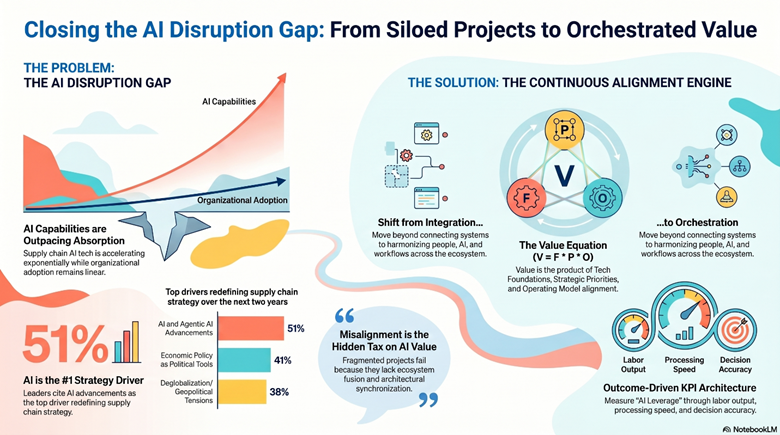
Yet many organizations are attempting to achieve operational modularity before achieving architectural modularity. That creates substantial risk. Without coherent enterprise intelligence, modularity can easily devolve into distributed fragmentation. Organizations may become more flexible operationally while simultaneously becoming less coherent strategically. Ecosystems may expand faster than governance capabilities mature. AI-driven decisions may outpace organizational coordination mechanisms. This is why Enterprise Architecture and Solutions Architecture are becoming increasingly important again — but only if they evolve beyond static documentation and repository-centric thinking.
The orchestrated enterprise requires architecture disciplines capable of continuously synchronizing:
- intelligence
- governance
- AI
- ecosystems
- capabilities
- operating models
- decision frameworks
- value delivery
- strategic intent
in real time.
This represents a significant evolution in the role of architecture itself. Architecture can no longer remain focused primarily on describing structures and defining target states. Increasingly, architecture must help enterprises continuously interpret, coordinate, govern, orchestrate, and adapt while transformation is actively occurring. The Gartner Supply Chain Conference 2026 revealed that this future is already emerging.
The organizations likely to lead in the coming decade will not simply possess more dashboards, more data, or more AI pilots. They will distinguish themselves through their ability to continuously harmonize intelligence across increasingly dynamic ecosystems. They will synchronize decisions faster, govern AI more coherently, orchestrate value delivery more adaptively, and align operations more effectively across distributed enterprise networks. In that future, visibility becomes merely the starting point. The true differentiator becomes orchestrated enterprise intelligence.