
Insights Expected from the Gartner IT Symposium/Xpo 2026
By Steve Else, Ph.D.
I have been reporting on Gartner conferences for more than a quarter century, watching technologies rise, peak, merge into the mainstream, disappear from view, and sometimes return under new names. As I prepare for Gartner IT Symposium/Xpo 2026, however, I see something more consequential taking shape. The convergence of agentic AI, runtime governance, AI economics, new operating models, context intelligence, increasingly autonomous actors, and continuous enterprise redesign suggests that one of the most consequential reinventions of Enterprise Architecture in decades may now be just around the corner.
That is the proposition I intend to test in Orlando. My central question is not simply what Gartner is saying about AI, nor which technologies enterprises should adopt next. The larger architectural question is whether we are watching the shape of the enterprise itself begin to change—and, if so, whether Enterprise Architecture must change with it.
That is the perspective I intend to bring to Gartner IT Symposium/Xpo 2026: not simply as a reporter cataloguing announcements and sessions, and not merely as an Enterprise Architect seeking confirmation of established practices, but as someone trying to assemble the pieces of a rapidly changing enterprise into a coherent architectural whole.
Gartner has selected “Ignite Intelligence” as its 2026 conference theme, emphasizing the combination of human ingenuity and AI in the intelligent enterprise. More than 7,000 CIOs and senior leaders are expected in Orlando, together with more than 140 Gartner experts, 180 solution providers, and more than 350 sessions. The opening Gartner keynote is provocatively titled “Reaching Escape Velocity — Shaping an Effective Enterprise AI Economy.”
Those words deserve architectural attention. An enterprise AI economy implies far more than buying AI tools. Economies have actors, resources, exchanges, incentives, limits, ownership, accountability, and rules. AI agents consume resources, invoke services, make or influence decisions, interact with people and other agents, create costs, and—one hopes—produce outcomes worth more than they consume.
The architectural implications follow immediately. Who designs that system? Who establishes its boundaries? Who understands how its components interact? Who determines how much autonomy an artificial actor should receive? Who connects AI economics to enterprise value? And who ensures that optimizing one part of this emerging AI economy does not damage the enterprise as a whole?
Those are Enterprise Architecture questions. Yet that does not automatically mean that today’s Enterprise Architecture is ready to answer them. That is precisely why consequential EA reinvention may now be around the corner.
Gartner May Be Describing a New Enterprise Architecture Without Drawing It as One
The most interesting development I see as I prepare for Orlando is not any single Gartner prediction, but the convergence among many of them.
Recent Gartner research spans agentic AI, AI economics, new operating models, continuous work redesign, governance, application disruption, agent identity, runtime controls, AI-ready information, software engineering, EA tooling, digital twins, and the changing relationship between centralized IT and business-led technology creation. Read separately, these are compelling technology and management subjects. Read architecturally, they begin to look like different views of the same transformation.
Gartner’s 2027 CIO planning research provides a useful starting point. IT budgets are projected to rise by an average of only 3.7%, while funding for agentic AI is expected to increase by an average of 31.8%. Gartner reports that 37% of respondents have already deployed AI agents and another 34% plan to do so within the next 12 months. At the same time, 73% of enterprises reportedly have no plans to establish rules assigning ownership of technology costs and solutions even as more technology development moves outside centralized IT. Only 13% of respondents report significant value from AI tools so far.
That is more than an AI adoption problem. It is an architectural disequilibrium in which investment is accelerating faster than governance, agency is decentralizing faster than accountability, and technology creation is becoming easier faster than organizations can understand the estates they are creating. AI capability is increasing faster than many enterprises can determine its value, while business demand is accelerating faster than traditional architecture, funding, and operating models were designed to accommodate.
The useful question for Enterprise Architects in 2026 may therefore be less about how to architect AI and more about how Enterprise Architecture itself must change when intelligence, decision-making, and technology creation become distributed throughout the enterprise.
From the AI-Enabled Enterprise to the AI-Shaped Enterprise
One of Gartner’s more useful phrases this year is the AI-shaped organization. Gartner argues that early AI-era leaders may discover that they focused too heavily on automation when the larger opportunity was workforce amplification. Its recent research describes an AI-shaped organization in which AI value compounds through redesigned roles and workflows that can cross traditional organizational boundaries.
That distinction deserves to be elevated from organizational design into Enterprise Architecture.
An AI-enabled enterprise adds AI to an existing enterprise. An AI-shaped enterprise changes because AI exists.
The difference is profound. An AI-enabled enterprise may install copilots, automate customer-service responses, summarize documents, augment software development, improve forecasting, and insert agents into existing workflows while leaving the organization chart, application portfolio, governance system, decision rights, jobs, and processes fundamentally intact.
An AI-shaped enterprise asks different questions. It asks what work should exist at all, which outcomes the enterprise is trying to create, where human judgment is indispensable, where machines can perform more effectively, and where people and artificial actors should collaborate. It also asks which decisions can be delegated, which must remain human, and what organizational boundaries still matter when an agent can orchestrate work across multiple functions and applications in seconds.
In such an enterprise, intelligence itself becomes an architectural resource.
My working definition, which I intend to test throughout Gartner Symposium, is therefore this:
An AI-Shaped Enterprise is an adaptive enterprise in which human and artificial actors, capabilities, information, decisions, services, and technologies are deliberately architected as an integrated system so that intelligence and appropriately bounded autonomy can be dynamically applied to produce worthwhile outcomes.
The critical word is not AI. It is shaped.
Agents Aren’t Merely Another Kind of Application
One of the recurring dangers in every technology cycle is that we force the new thing into conceptual containers created for the old thing. We called websites applications, we often treat platforms as applications, and now we risk doing the same with agents.
Yet an autonomous agent has characteristics that make that analogy increasingly inadequate. An application generally waits to be used; an agent may initiate. An application performs functions; an agent may pursue goals. An application usually follows comparatively deterministic workflows; an agent may reason probabilistically about how to achieve an outcome. An application traditionally exposes capabilities to a person through an interface; an agent may discover and invoke capabilities across multiple systems without a person interacting with those interfaces at all.
This distinction is becoming economically significant. Gartner estimates that up to $234 billion in enterprise application software spending could be exposed to agentic arbitrage by 2030, as agents complete work across systems and reduce the need for users to interact directly with traditional application interfaces.
For Enterprise Architecture, the more interesting question is not whether SaaS vendors lose revenue. It is whether the application remains the most useful unit around which to organize architecture when the user increasingly interacts with an agent rather than with the application itself.
Perhaps the more durable architectural elements become business capabilities, information, semantics, services, APIs, policies, decision rights, identity, and outcomes. Applications could become increasingly replaceable containers around those more persistent enterprise assets.
Gartner’s 2027-and-beyond predictions make that possibility even more striking. Gartner predicts that by 2029, 80% of new applications will be intentionally disposable and used for less than one year as AI-assisted development makes temporary software easier to create.
That has enormous implications for traditional Application Portfolio Management. For decades we have treated applications as relatively durable assets and tracked their ownership, technologies, costs, business criticality, lifecycle state, integrations, technical debt, and rationalization opportunities. If applications become increasingly ephemeral, we may need to invert the model and treat capabilities, enterprise information, services, policies, and architectural intent as persistent while applications become more temporary implementations. That would not mean the death of Application Architecture. It might represent its liberation from treating the application itself as the most enduring unit of enterprise structure.
Ten Billion Agents Would Change the Unit of Architecture
Gartner’s strategic predictions push the scale even further. By the end of 2030, Gartner predicts that more than 10 billion autonomous agents created by individuals, enterprises, and governments could interact with public services.
Whether the eventual number is ten billion, five billion, or twenty billion is less important architecturally than the direction of travel. The digital enterprise is acquiring actors. That changes the ontology of enterprise systems.
Traditional enterprise systems contain users, applications, processes, services, and data. The emerging enterprise contains human actors and artificial actors that may collaborate, negotiate, consume one another’s services, pass work among themselves, represent individuals or organizations, exercise different scopes of authority, exist only briefly, and act across organizational boundaries.
That means architecture can no longer ask only what system performs a function. It must increasingly ask what actor is permitted to perform an action, on whose behalf, under what conditions, using which information, and with what degree of autonomy. That is a profound expansion of Enterprise Architecture.
Intelligence Does Not Imply Authority
This may be one of the most important architectural principles I intend to carry into Orlando:
Intelligence does not imply authority.
An AI system may possess extraordinary reasoning capabilities yet have no authority to execute an irreversible business action. Conversely, a comparatively simple system might receive significant execution authority within narrow, carefully controlled circumstances. We therefore need to stop discussing autonomy as though it were binary.
Gartner’s Orlando topic framing is already moving in this direction by encouraging CIOs to build staged autonomy roadmaps, adopt governance-by-design, and provide appropriate controls, observability, and oversight. Gartner’s recent infrastructure-governance research goes further, recommending that agents be treated as distinct nonhuman identities with defined ownership, centrally registered identity, dynamic least privilege, and temporary access that disappears when the relevant task ends.
Especially important is Gartner’s recommendation to separate reasoning from execution. The agent may decide or propose what should happen, while a separate control layer evaluates whether that proposed action should actually occur.
That distinction is architecturally elegant because it clarifies three concepts that are often confused:
Reasoning is not execution. Capability is not permission. Intelligence is not authority.
This suggests the need for an explicit Architecture of Authority.
The emerging chain may look like this:
Actor → Role → Decision Right → Authority → Autonomy → Guardrail → Action → Evidence → Accountability
An enterprise that cannot describe that chain may discover that it has automated activity without adequately architecting responsibility.
Governance Must Move From Documents Into Execution
Architecture governance has traditionally had a periodic character. We establish principles, define standards, review designs, examine conformance, approve exceptions, and conduct implementation governance. Agentic AI challenges the speed assumptions behind that model.
A governance committee does not operate at machine speed. A policy document cannot physically prevent an agent from executing a dangerous command. An architecture review completed months earlier cannot intervene when an autonomous workflow enters an unexpected state at two o’clock in the morning.
Gartner increasingly argues that governance must become operational. That should trigger an important conversation within Enterprise Architecture. If architectural principles matter, can some of them become executable? If guardrails matter, how are they represented in runtime environments? If the architecture defines permitted relationships among systems and information, can changes to those relationships be observed automatically? If an agent attempts to operate outside its authorized scope, can architectural policy stop it?
This points toward an important future direction: architecture that remains connected to execution.
Architecture has historically described the intended enterprise. The AI-shaped enterprise may require architecture that can also sense the operating enterprise, compare actual behavior with architectural intent, and help trigger corrective action when the two diverge. That is a major shift.
Context May Become as Important as Data
Agents create another architectural complication: data by itself is frequently insufficient. A customer number is data. Knowing that the customer is currently disputing a transaction is context. A product identifier is data. Knowing that the product has been recalled in a particular country is context. An employee record is data. Knowing that the employee is temporarily fulfilling another role with delegated authority is context.
AI, particularly agentic AI, requires more than access to databases. It increasingly requires the ability to interpret enterprise meaning well enough to act appropriately.
That leads me to ask whether Context Architecture deserves to become a more explicit EA concern. Data Architecture traditionally asks what information exists, how it is structured, where it resides, how it flows, and how it is governed. Context Architecture would ask something slightly different: what does the enterprise need an artificial actor to understand in order to interpret that information correctly? That could include semantics, relationships, provenance, temporal context, location, jurisdiction, policies, identity, business rules, permissions, and institutional knowledge. An autonomous enterprise cannot safely be more intelligent than the context it can reliably construct.
The architecture of the AI-shaped enterprise may therefore depend upon a continuous chain:
Data → Meaning → Context → Decision → Authority → Action
If one of those links fails, autonomy becomes much harder to trust.
The Enterprise AI Economy Is an Architecture Problem
The title of Gartner’s Orlando opening keynote—“Shaping an Effective Enterprise AI Economy”—may prove particularly important because AI economics are already more complicated than the popular discussion about declining model costs suggests.
The same agentic business outcome may require different numbers of reasoning steps, model calls, tool invocations, retries, and human escalations. That means architectural choices create economic commitments.
The EA community has traditionally been stronger at explaining structural dependencies than economic ones. That needs to change. If Gartner is correct that the enterprise is developing an AI economy, architecture must connect technical structure to business value. Enterprise Architects should be asking what an architecture costs per meaningful outcome, what business value additional autonomy produces, where the marginal value of additional intelligence begins to decline, what human oversight costs, and what insufficient oversight may cost. Enterprise Architects should not wait until FinOps discovers these relationships for us. Architecture itself needs to become more economically literate.
Valuable? Executable? Impactful?
One of the lenses I intend to bring to Gartner Symposium is a simple one I have been developing independently:
VEI™ — Valuable? Executable? Impactful?
The order matters.
A technology can be executable without being valuable. An initiative can appear valuable while being essentially impossible to execute within the organization’s constraints. And an initiative can be valuable and executable yet create too little impact to justify investment relative to competing priorities.
Agentic AI makes these distinctions particularly important because technological feasibility can seduce organizations into action. The question “Can an agent do this?” is less useful than “Should an agent do this?” Even that is incomplete. The enterprise must also ask whether allowing the agent to do it will create enough value to matter. That is the level at which Enterprise Architecture should increasingly operate.
AI Is Changing the Tempo of Architecture
Another important Gartner theme is continuous work redesign. Organizations are being encouraged to continuously redesign workflows, decision rights, jobs, and talent deployment as AI capabilities, priorities, and execution conditions change.
From an EA perspective, that is approaching the territory of continuous enterprise redesign.
Traditional EA has often operated through relatively discrete cycles: understand the current state, develop target architecture, identify gaps, establish roadmaps, govern implementation, and repeat. That model remains useful, but it raises an obvious question when change occurs faster than a target architecture can remain current.
Perhaps the future is not the disappearance of target architecture, but the transition from relatively static targets toward continuously recalculated architectural direction.
The model becomes:
Sense → Interpret → Model → Decide → Act → Observe → Learn → Re-architect
This is one reason I have been developing the concept of a Continuous Adaptive Intelligence Loop™ (CAIL™).
The core issue is architectural cognition. How does the enterprise continuously recognize meaningful change? How does it determine whether architectural assumptions still hold? How does it distinguish signals from noise? How does operational evidence feed back into architectural decisions while those decisions still matter?
Gartner’s own recent EA research points in a compatible direction through its discussion of agentic EA intelligence and the future digital twin of the organization. That may prove to be one of the most consequential EA directions of the year because it suggests that EA’s future is not simply a repository. It is an intelligence capability.
Enterprise Architecture Is Also on Trial
It would be convenient for architects to conclude that these developments prove Enterprise Architecture is finally becoming indispensable. I think that conclusion is premature.
The same Gartner program that creates enormous opportunity for EA also challenges the profession directly. The Orlando conference includes a dedicated Enterprise Architecture Spotlight, with featured sessions such as “When EA Fails the CIO: Focus on What Matters, Move Faster and Prove Real Value” and “The Hard Truth: Your Architects Aren’t Working Together — Here’s How to Fix It.”
Those titles should make architects uncomfortable. That is healthy.
If agentic AI increases the pace of change while architecture remains slow, EA loses relevance. If business teams create solutions faster while architecture remains centralized around approval boards, EA becomes a bottleneck. If architecture accumulates models that executives rarely use, AI will simply make irrelevant modeling faster. The AI-shaped enterprise therefore represents both EA’s opportunity and EA’s examination.
To deserve greater strategic influence, EA must become faster without becoming superficial, broader without becoming vague, more evidence-driven without collapsing into dashboard management, closer to execution without becoming engineering, more economically aware without becoming finance, and more continuously adaptive without creating architecture churn. That is not a minor evolution. It is the consequential reinvention that may now be approaching.
From Architecture Repository to Architecture Intelligence
For years, architecture-tool discussions have often centered on repositories. We ask what entities should be inventoried, which metamodel should be used, which relationships should be maintained, how they should be visualized, and how current the information is. The AI-shaped enterprise needs more.
Imagine an architecture capability that can continuously combine enterprise strategy, capabilities, value streams, applications, data, technology, cost, security posture, projects, portfolios, technical debt, contracts, supplier risk, observability data, agent registries, AI costs, and business performance. Then imagine agentic systems capable not merely of retrieving that information but of recognizing architectural consequences.
A proposed agent might duplicate an existing capability. A business unit’s AI initiative might create new dependency on a model provider already approaching concentration-risk limits. A legacy application might become unnecessary if an agentic workflow proves viable. An autonomous decision might cross a jurisdictional boundary. A proposed design might produce an inference cost greater than the value of the target outcome. An architectural assumption might no longer be supported by operational evidence. At that point, EA becomes something qualitatively different.
Not merely an architecture repository.
Not simply an architecture-management tool.
An architecture intelligence system.
The human architect does not disappear. The human architect moves upward, from manually assembling information toward exercising judgment over evidence, assumptions, tradeoffs, consequences, and direction.
Human Judgment May Become More Important, Not Less
There is an understandable assumption that as machines become more intelligent, human judgment becomes less important. I suspect the opposite will often be true. As production becomes easier, discernment becomes harder. If AI can create ten alternatives in the time a human previously created one, someone still has to judge ten alternatives. If agents can initiate actions autonomously, someone must decide what authority they should receive. If AI can generate architecture models automatically, someone must still determine which relationships matter and which are noise.
That is why I believe the traditional professional-development vocabulary of knowledge, skills, experience, and maturity needs another explicit element:
judgment.
AI may democratize access to intelligence. It will not automatically democratize wisdom.
The Conference Floor Is Part of the Research
Gartner Symposium is not simply a collection of analyst presentations. The IT Xpo floor itself will be a research laboratory. I do not intend to ask vendors merely what is new in their products. A more useful discussion starts with architecture.
Where does the agent sit in the enterprise architecture? What enterprise context does it require? What may it access? What can it decide? What may it execute? Who owns it? How is its authority granted, monitored, reduced, or withdrawn? How does it interact with other agents? What happens when another vendor’s agent invokes it? How is agent cost measured against business outcome? How does the enterprise preserve its independence from the vendor’s platform?
Perhaps the most revealing question is simpler:
What assumption does your product make about the enterprise that buys it?
Products reveal architectures, sometimes unintentionally. A vendor that assumes centralized decision-making embeds one architectural worldview. A platform that assumes autonomy should be maximized embeds another. A system that assumes the application remains the primary unit of work embeds another. A vendor that assumes context should live inside its proprietary platform creates another kind of dependency.
Part of my job in Orlando will be to make those assumptions visible.
Delegates May Tell an Equally Important Story
The analyst presentation describes Gartner’s research. The vendor demonstrates what can be sold. The delegate describes what can actually be lived with.
That third voice matters enormously.
I intend to listen closely to what CIOs, architects, engineers, business leaders, and other practitioners say about their actual problems. Are organizations truly deploying autonomous agents, or mainly sophisticated assistants? Who owns those agents? Are architecture teams involved early enough to influence decisions? Are enterprises creating agent inventories? Are they integrating EA with FinOps? Are they redesigning work or simply automating existing work? Is AI making EA more relevant, or are business leaders simply moving around it even faster?
The conference therefore becomes an opportunity to triangulate among what analysts foresee, what vendors promise, and what practitioners experience. That triangulation will be central to my reporting.
My Working Architecture of the AI-Shaped Enterprise
As I enter Gartner Symposium, I am starting with a provisional architectural model. It is not intended as a finished framework, but as something to test against what I hear and observe.
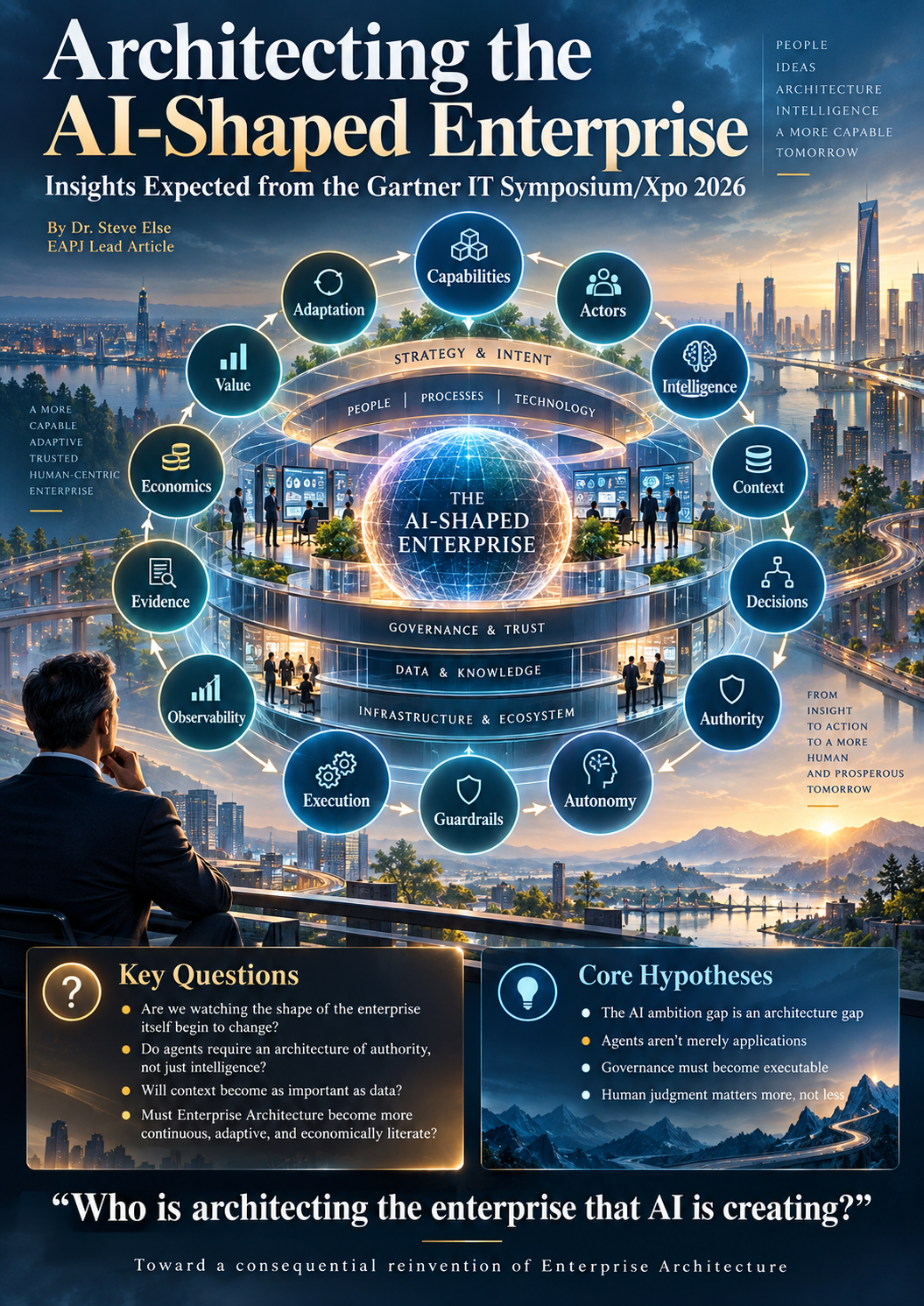
An AI-shaped enterprise appears increasingly to require an integrated architecture of Capabilities, defining what the enterprise must be able to accomplish; Actors, including both people and artificial actors; Intelligence, describing the reasoning and analytical capabilities available to those actors; and Context, supplying the business meaning required to interpret information correctly.
It also requires an architecture of Decisions, defining where choices occur; Authority, defining who or what may make those choices; and Autonomy, defining how far action may proceed without additional intervention. Those elements must be bounded by Guardrails, connected through Execution, and made transparent through Observability and Evidence.
Finally, the enterprise must understand Economics, determine Value, and support Adaptation as conditions, capabilities, and priorities change. That is far more than an AI architecture. It begins to resemble an architecture of the autonomous enterprise.
My hypothesis is that Gartner is already describing many of these elements, but across different research disciplines, roles, and conference sessions. My task at Symposium will be to see whether those pieces form a coherent whole.
What I Will Be Testing in Orlando
Rather than arriving with conclusions already written, I am going to Orlando with a set of architectural hypotheses.
The first is that the AI ambition gap is fundamentally an architecture gap. Organizations may be acquiring AI capability faster than they can redesign governance, funding, operating models, information structures, and accountability.
The second is that agents are not simply another category of application. If they become autonomous enterprise actors, architecture must model identity, role, authority, context, and action—not merely application functionality.
The third is that the application may become a less durable unit of architecture. If Gartner’s disposable-application prediction proves directionally correct, persistent capabilities, information, services, policies, and architectural intent may matter more than persistent application portfolios.
The fourth is that autonomy is not binary. Enterprise Architecture needs a language for describing how decision and execution authority can be granted, constrained, observed, suspended, and revoked.
The fifth is that governance will increasingly become executable. Architecture governance cannot operate solely through boards, reviews, and documents when autonomous systems execute at machine speed.
The sixth is that context will become an explicit architectural asset. Agents need meaning, relationships, provenance, and policy context—not simply access to raw data.
The seventh is that AI economics belongs inside the architecture conversation. Architects must understand cost per outcome, not merely technology cost.
The eighth is that Enterprise Architecture itself must become more continuous. If organizations continuously redesign workflows, jobs, and decision rights, architecture cannot remain a periodically refreshed picture of the enterprise.
The ninth is that architecture intelligence will increasingly augment architecture documentation. The future EA environment may continuously sense, analyze, and advise rather than simply store artifacts.
The tenth is that human judgment becomes more important as machine intelligence becomes more plentiful.
Those are hypotheses, not conclusions. I hope Gartner challenges some of them. That is precisely what serious conference coverage should accomplish.
Why This Matters Beyond Enterprise Architects
I do not want this coverage to become an EA conversation conducted only among Enterprise Architects. For CIOs, these questions affect governance, technology investment, and organizational responsibility. For CFOs, they affect AI economics, operating expense, and accountability for value. For business leaders, they affect how work is designed and who—or what—is authorized to perform it. For CISOs, they affect machine identity, trust boundaries, and autonomous access. For data leaders, they affect the construction and governance of AI-ready context. For HR leaders, they affect roles, skills, workforce amplification, and human judgment. For vendors, they affect interoperability, ecosystem strategy, and customer dependence.
Enterprise Architecture sits at the intersection of these concerns. That does not automatically give Enterprise Architects ownership of them, but it does create an opportunity for EA to become the discipline that integrates them. Integration may become our greatest contribution.
Beyond the Framework Wars
The AI-shaped enterprise will not fit neatly inside any single framework.
TOGAF remains valuable. ArchiMate remains valuable. Business Architecture remains valuable. Systems Engineering, product thinking, FinOps, cybersecurity architecture, and data governance all contribute important perspectives.
The architect’s job should not be to defend conceptual territory. It should be to create coherence. That is the larger intent behind what I call Integrale Architecture™: not another framework competing for shelf space, but a conviction that modern enterprises require architectural integration across disciplines, domains, methods, technologies, and viewpoints. [See IntegraleArchitecture.com, where VEI and CAIL are also defined.]
Agentic AI makes that need increasingly visible. When an AI agent moves from a customer interaction to a business process, accesses data, invokes an API, incurs model cost, exercises decision authority, triggers a financial transaction, and creates a compliance obligation, the enterprise does not care that six professional disciplines describe six pieces of the event. The enterprise experiences one action. Architecture must be capable of seeing the whole.
The North Star Must Remain Human
For all the discussion of autonomous agents, intelligent enterprises, and AI economies, I do not want the reporting to lose sight of people. A technologically magnificent enterprise could still be a badly designed human enterprise. Efficiency is not synonymous with value. Automation is not synonymous with progress. Autonomy is not synonymous with wisdom.
The purpose of Enterprise Architecture is not to produce elegant diagrams, nor should its purpose become the maximization of machine autonomy. Its purpose is ultimately to help enterprises accomplish meaningful outcomes within real constraints for real stakeholders.
That suggests a North Star:
Human agency and enterprise value should improve as artificial agency increases.
If greater artificial autonomy diminishes human ability to understand, intervene, challenge, or redirect the enterprise, we may have optimized the wrong thing. The AI-shaped enterprise should not be an enterprise in which machines replace human purpose. It should be one in which architecture helps increasingly sophisticated human and artificial intelligence work coherently toward purpose.
From Orlando to a Larger Conversation
My coverage of Gartner IT Symposium/Xpo 2026 will therefore not be a four-day exercise. Orlando will be the beginning of a longer synthesis. During the conference I intend to examine Gartner research, analyst presentations, the Enterprise Architecture Spotlight, agentic-AI sessions, operating-model discussions, technology economics, governance, the vendor floor, and—critically—the experiences of delegates.
Afterward, the more important work begins. What did the pieces mean together? Where did Gartner’s research reinforce itself? Where did different sessions reveal tensions? Where did vendor claims align with Gartner’s architectural concerns? Where did practitioners disagree? What implications became visible across sessions that no individual session was designed to address? And, perhaps most importantly, what should an Enterprise Architect actually do on Monday morning?
Conference reporting is too often chronological: what happened on Monday, what happened on Tuesday, and what the top ten takeaways were. I intend to approach it architecturally instead by asking what emerged, what connected, what conflicted, what changed, what appears temporary, what appears structural, and what kind of enterprise is taking shape.
Perhaps This Is Enterprise Architecture’s Moment — If We Earn It
Enterprise Architecture has repeatedly been declared dead, reinvented, rebranded, and rediscovered. I am less interested in defending the profession than in asking whether it remains useful. Agentic AI presents an extraordinary test.
If the future enterprise contains human and artificial actors exercising varying levels of authority across rapidly changing capabilities, temporary applications, contextual information environments, and continuously redesigned workflows, the need for architectural thinking should increase dramatically. But the need for traditional EA activity does not necessarily increase with it. That distinction matters.
The future will not reward architecture merely because we have repositories, because we know frameworks, or because complexity is increasing. It will reward architecture if architects can make increasing complexity understandable, governable, economically rational, and adaptable.
It will reward us if we help organizations recognize connections they otherwise would have missed, if we prevent local optimization from damaging enterprise outcomes, if we can translate strategy into executable change and operational evidence back into strategic understanding, and if we can make human and artificial agency work together deliberately rather than accidentally.
That is why I am approaching Gartner IT Symposium/Xpo 2026 with considerable anticipation. Not because Gartner will tell us exactly what the future enterprise looks like; I doubt anyone can. But Gartner has already assembled an unusually rich collection of signals: an AI-shaped organization, an enterprise AI economy, massive populations of autonomous agents, staged autonomy, runtime governance, agent identity, dynamic redesign, AI FinOps, disposable applications, agentic EA intelligence, digital twins, contextual information, new operating models, and a renewed challenge for Enterprise Architecture to move faster and prove value.
Perhaps these are separate developments. Perhaps not. My working hypothesis is that they are fragments of something much larger:
The emergence of the AI-Shaped Enterprise—and with it, a consequential reinvention of Enterprise Architecture.
I intend to go to Orlando looking for the architecture behind the announcements. I will listen to Gartner, challenge the implications, question vendors, learn from delegates, look for contradictions as carefully as confirmations, and try to connect what might otherwise remain disconnected.
Because the most important question coming out of Gartner IT Symposium/Xpo 2026 may not be:
What will AI do next?
It may be:
Who is architecting the enterprise that AI is creating?
That is the question I intend to pursue.
And I suspect the answer will tell us just how close that consequential EA reinvention really is.
Author’s note: This article represents the author’s independent analysis and pre-conference hypotheses. Gartner and Gartner IT Symposium/Xpo are trademarks of Gartner, Inc. Gartner does not sponsor or endorse this article. Gartner predictions and conference information cited here are drawn from publicly available Gartner materials current as of September 29, 2026.