
API Caching as an Enterprise Architecture Decision: A Governance Framework for Large-Scale Enterprise Cloud Platforms
by Satish Chavali
Abstract
API caching decisions in large enterprise cloud platforms are almost always made at the engineering layer — a developer sets a TTL, a team agrees on a cache-control header, and the decision is done. But in large-scale enterprise cloud environments, where dozens of modules share data across integration boundaries and every API call is metered, those decisions carry consequences that reach far beyond the team that made them: data consistency failures, unexpected cloud costs, and integration instability that surfaces during peak transaction windows or year-end processing cycles. This paper presents a practitioner-oriented framework proposal arguing that API caching is an architectural concern, not an engineering detail, and that Enterprise Architecture frameworks — specifically TOGAF’s Architecture Development Method — provide the governance structure needed to treat it that way. Drawing on HTTP caching standards, enterprise integration literature, and production patterns in API gateway platforms, we propose a four-dimension caching governance framework — Consistency, Cost, Latency, and Compliance (C2LC) — mapped to TOGAF’s ADM phases, and offer practitioners a decision model for applying it in enterprise cloud integration contexts. We further examine common cache invalidation patterns, a tiered implementation roadmap, and the organizational conditions that determine whether caching governance takes hold or remains a well-intentioned artifact.
Keywords: API caching; enterprise architecture; TOGAF; enterprise cloud; API gateway; cache governance; data consistency; cloud cost optimization; DevOps; integration architecture; cache invalidation; HTTP caching
1. Introduction
There is a moment familiar to anyone who has run a large enterprise cloud platform: a batch processing job fails silently during a high-load period, and the root cause turns out to be a cached master data record that was updated six hours ago but whose cache entry had not yet expired. The downstream processing service was working perfectly — it was consuming the data it had been given. The data was just wrong. Not wrong in the database, but wrong in the cache layer that sat between the data-of-record service and the consuming engine.
This kind of failure is rarely framed as an architecture problem. It gets logged as a caching bug, assigned to the team that owns the API gateway configuration, fixed with a TTL adjustment, and closed. The architectural question — *who should be deciding caching policy for integration-critical data flows, and according to what governance process?* — goes unasked.
This paper asks that question. Enterprise cloud platforms are deeply integrated systems: core data-of-record services share data with transaction processing engines, operational workflows, analytics dashboards, and reporting systems, all through API layers that carry caching policies embedded in HTTP headers or API gateway configuration [1,2]. Those caching policies are architectural decisions. They determine data consistency guarantees across module boundaries. They determine how much cloud infrastructure a platform consumes — and in a metered cloud environment, every unnecessary API call has a cost. They determine whether the system remains stable when it is handling the peak loads that enterprise business events generate: bulk batch runs, peak transaction periods, and year-end reporting cycles.
TOGAF’s Architecture Development Method (ADM) provides a governance cycle that covers business, data, application, and technology architecture [3]. Yet in most enterprise cloud engineering organizations, API caching policy is never touched by EA governance. It lives in the application or technology layer, implemented by individual teams without reference to cross-module data consistency requirements, cost optimization targets, or compliance obligations around data freshness. The result is what might be called *caching sprawl* — a patchwork of locally rational but globally inconsistent caching decisions that accumulates technical risk with every release cycle.
The framework proposed in this paper does not ask enterprise architects to become caching engineers. It asks them to recognize that caching policy is an architectural artifact — one that belongs in the Architecture Repository alongside API contracts, data models, and integration standards — and to apply the governance discipline that TOGAF’s ADM already provides.
1.1 What C2LC Contributes
C2LC addresses a governance gap that existing frameworks do not fill. TOGAF’s ADM defines governance phases for business, data, application, and technology architecture [3] but contains no guidance specifying where caching policy decisions belong in that cycle or which stakeholders should own them. HTTP caching standards, including RFC 9111 [5], define the technical mechanisms for caching policy — the cache-control directive system, conditional request protocols, and expiry semantics — but do not prescribe organizational governance processes for deciding when and how to apply those mechanisms. API management platform documentation [6] addresses gateway configuration and performance tuning but not cross-team architectural governance. Research into high-performing engineering organizations establishes the value of loosely coupled architectures [7], but does not address the governance of caching policy within those architectures.
The result is a structural gap: caching policy decisions sit at the intersection of business architecture (data freshness requirements), data architecture (consistency classifications), application architecture (latency requirements), technology architecture (gateway configuration and cost), and compliance (regulatory data retention obligations). No existing framework assigns responsibility for those decisions to any of these layers.
C2LC fills this gap by providing: (a) a four-dimension vocabulary for framing caching policy as an architectural concern rather than an engineering detail; (b) a mapping of those dimensions to specific TOGAF ADM phases, embedding governance in a cycle most enterprise architecture teams already operate; and (c) a tiered governance model that scales oversight to architectural risk rather than applying uniform overhead to every caching decision. The framework’s contribution is integrative rather than inventive: the dimensions are individually well-understood, but their synthesis into a single governance model, positioned at the caching decision point within the ADM lifecycle, has not been formalized in the existing EA or API governance literature.
2. Why Caching Matters at the Architecture Layer
2.1 Caching as an Architectural Constraint in REST
The case for treating caching as an architectural concern starts with the foundational theory of the web. Roy Fielding’s original REST dissertation identified cacheability as one of the six defining architectural constraints of the REST architectural style [4]. His argument was not about performance optimization; it was about *architectural integrity* — the principle that a distributed system’s components should be able to make explicit decisions about the reusability of responses, and that those decisions should be governed by a consistent policy rather than left to individual implementation choices.
HTTP RFC 9111 operationalizes this constraint through the cache-control directive system, defining how clients, intermediaries, and servers negotiate caching behavior through response headers [5]. Richardson and Ruby [2] situate this within the broader principle that RESTful systems treat HTTP semantics — including caching — as architectural contracts rather than implementation hints. What is significant from an EA perspective is that the standard explicitly frames caching as a *policy* decision: `Cache-Control: no-store` is a policy statement. `max-age=3600` is a policy statement. These policies propagate across every layer of a distributed system — API gateways, CDN edges, client-side caches — and their effects compound across integration boundaries in ways that no single engineering team can fully observe.
In a multi-module enterprise platform, this means that a caching policy set by one service team on its data API affects the freshness guarantees available to the transaction processing team, the reporting team, and the analytics team — none of whom were party to the original decision.
2.2 The Cost Dimension in Metered Cloud Environments
Enterprise cloud platforms are consumed in metered environments where infrastructure costs are directly proportional to API call volume, compute consumption, and data transfer. In this context, caching policy is not just a performance question — it is a cost governance question.
A poorly designed caching strategy in an enterprise API gateway generates two categories of cost: the direct cost of unnecessary API calls that bypass available caches and hit backend services, and the indirect cost of cache invalidation failures that force emergency backend calls during high-load periods. API gateway platforms identify response caching as one of the primary policy mechanisms for reducing backend load — but backend load in a cloud environment is metered cost, not just a performance metric [6].
Research into high-performing engineering organizations establishes that elite-performing teams achieve deployment frequency and recovery time advantages through loosely coupled architectures and automated delivery practices [7,15]. What that research does not address explicitly is the cost dimension of these architectural choices — the reality that in metered cloud environments, architectural decisions about caching, retry policies, and API call patterns translate directly into monthly infrastructure invoices. For large enterprise platforms processing millions of transactions, this is not a rounding error.
2.3 Data Consistency as an Integration Risk
The hardest caching problem in enterprise architecture is not performance — it is consistency. When a master data record changes — a customer status, a product classification, an account configuration — that change must propagate correctly to every downstream system that consumes it, within a timeframe that the consuming system’s business logic can tolerate.
This is a data architecture problem before it is a caching problem, and it belongs in TOGAF’s Phase C (Information Systems Architecture). But it manifests as a caching problem in production. The TTL on a master data API response determines the maximum staleness window for every system that caches it. If a transaction processing engine caches entity classification data with a one-hour TTL and a reclassification event occurs 45 minutes into that window, the processing job that starts 10 minutes later will operate under the wrong classification — not because the processing system is buggy, but because the caching policy was set without reference to the downstream system’s tolerance for data staleness.
This is the class of failure that Conway’s Law predicts and that EA governance is designed to prevent [8]. When caching policy is set by the team that owns the API, without reference to the consistency requirements of the teams that consume it, the resulting architecture reflects the team boundary rather than the data dependency.
2.4 Caching Failure Patterns in Enterprise Cloud Platforms
To ground the architectural argument in recognizable practice, this section catalogs the failure patterns that ungoverned caching produces in enterprise cloud environments. The three patterns described below are representative architectural archetypes documented in practitioner literature on distributed systems design [12,13]; they are not novel to this paper, but their specific governance implications in the enterprise EA context are the contribution being made here.
The stale master record failure. A master data record — entity status, configuration attribute, account classification — is updated in the system of record. Downstream systems consuming this record via a cached API response continue to operate on the pre-update value for the duration of the cache TTL. The failure surface is wide: transaction calculations, access control decisions, and reporting outputs may all reflect the stale value before any cache entry expires. In regulated industries, this can constitute a compliance violation before it is detected. Nygard [13] classifies this category of failure as a *integration point* failure mode in which the consumer’s dependency on freshness is invisible to the producer; it is preventable through consistent staleness tolerance documentation across architectural boundaries.
The cascade invalidation storm. A high-traffic API receives a cache invalidation signal — a record update, a schema change, or a cache flush triggered by a deployment. All cached entries for that API expire simultaneously. Every downstream consumer that was previously satisfied by the cache now sends a live request to the backend service. The backend, sized for steady-state cached traffic, receives a sudden spike that it cannot absorb. The result is a latency surge or partial outage that is indistinguishable from a denial-of-service event from the backend’s perspective. This pattern is documented in distributed systems practice as the *thundering herd* or *cache stampede* problem [12], and is particularly acute in enterprise platforms immediately following a major data migration or bulk record update, when invalidation events are large-scale and simultaneous.
The compliance lag. An end user submits a data erasure request under applicable privacy regulation. The underlying record is deleted from the system of record. However, the cached API response — containing the personal data — continues to be served to consuming systems for the remaining duration of the cache TTL. Under data erasure obligations such as GDPR Article 17 [14] and equivalent regulations in applicable jurisdictions, the system is technically compliant at the data layer but non-compliant at the API layer. This failure mode is architecturally invisible unless caching policy is reviewed against data governance requirements at design time.
Each of these failure patterns has a governance solution, not just a technical one. The stale master record failure is addressed by consistency classification governance. The cascade invalidation storm is addressed by cache warming and graduated invalidation patterns governed at the Technology Architecture layer. The compliance lag is addressed by compliance-aware TTL governance at the Business Architecture layer. All three belong in the C2LC framework.
3. The C2LC Framework: A Four-Dimension Caching Governance Model
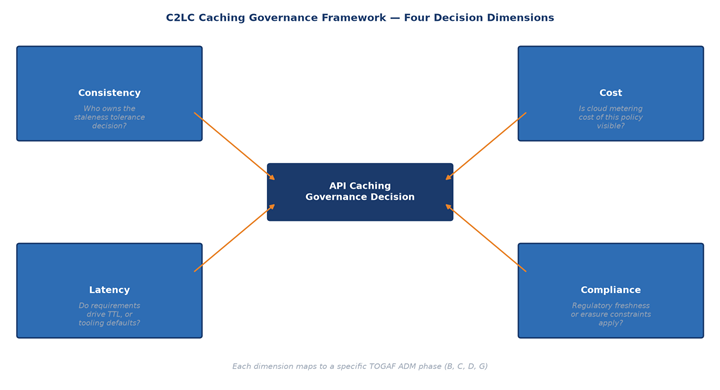
Figure 1 — C2LC Framework: four governance dimensions for API caching decisions
To address these concerns within an EA governance context, we propose the C2LC framework — a four-dimension decision model for evaluating and governing API caching decisions in large-scale enterprise cloud environments. The four dimensions are Consistency, Cost, Latency, and Compliance. The acronym C2LC encodes the two C-initial dimensions (Consistency and Cost) as the token “C2,” followed by L (Latency) and C (Compliance); the numeral 2 denotes the count of C-initial dimensions rather than an abbreviation.
The four dimensions were derived by mapping the failure patterns identified in Section 2.4 to the governance concerns each pattern represents. The stale master record failure and the compliance lag both involve failure of correct data delivery — generating the Consistency and Compliance dimensions. The cascade invalidation storm involves failure of cost-efficient, stable operation — generating the Cost and Latency dimensions. Together, the four dimensions cover the failure space that ungoverned caching produces in enterprise cloud environments.
Deliberate exclusions from scope include: technical cache implementation details (Redis configuration, distributed cache coherence protocols), service mesh sidecar caching, CDN origin shield design, and database query-result caching at the storage layer. These are engineering concerns governed by technology-layer decisions; C2LC addresses the architectural governance layer above them. The framework is not a replacement for engineering judgment — it is a governance lens that ensures the right stakeholders are involved in caching decisions and that those decisions are documented as architectural artifacts.
Table 1 — C2LC Governance Decision Matrix: mapping Consistency and Compliance classifications to governance level and recommended invalidation mechanism
| Consistency | Compliance Risk | Governance Level | Recommended Invalidation |
| High | High | ARB sign-off required | Event-driven invalidation |
| High | Low | ARB sign-off required | Event-driven or ETag/conditional |
| Medium | Any | Team + EA facilitation | TTL with randomized jitter |
| Low | Low | Team-level documentation | Long-window TTL |
Table 1 provides the operational entry point for C2LC governance: once an API is classified against the Consistency and Compliance dimensions, the governance level and candidate invalidation mechanism follow directly. The Cost and Latency dimensions then inform the specific TTL values and cache-tier sizing decisions within the governance level indicated.
3.1 Consistency
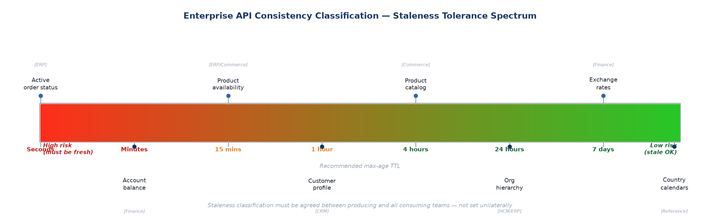
Figure 2 — Enterprise API staleness tolerance spectrum: high-consistency operational data (active orders, account balance) vs. low-consistency reference data (product catalog, exchange rates)
The Consistency dimension asks: *what is the maximum data staleness this API’s consumers can tolerate, and who owns the decision about that tolerance?*
Every API in an enterprise cloud platform sits somewhere on a spectrum from high-consistency (changes must propagate immediately or near-immediately) to low-consistency (consumers can tolerate stale data for hours or days). Transactional operational data — active order status, account balances, live pricing — sits at the high-consistency end with staleness windows measured in seconds or minutes. Intermediate data — product availability, customer profiles — tolerates staleness of 15 minutes to a few hours, where a short TTL with jitter is usually sufficient. Reference and configuration data — product catalogs, organizational hierarchies, exchange rates, country calendars — sits at the low-consistency end where a 24-hour or longer TTL is architecturally appropriate. Figure 2 illustrates this spectrum across representative enterprise domains (ERP, Finance, CRM, and reference data).
Governance implication: the consistency classification of an API should be determined jointly by the producing team and all consuming teams, documented in the Architecture Repository, and reviewed whenever the API’s data model or the consuming systems’ requirements change. It should not be set unilaterally by the producing team or inherited from a framework default.
3.2 Cost
The Cost dimension asks: *what is the total infrastructure cost of the current caching policy, and is that cost allocation intentional?*
In practice, most engineering teams do not know the dollar cost of their API’s caching policy. They know the TTL value and the cache hit ratio (if they are monitoring it), but they have not converted that into a line on the infrastructure cost model. In metered cloud environments, this is an architectural blind spot.
The total cost of a caching policy has four components: (a) the direct cost of backend compute calls that bypass the cache — in metered cloud environments, each API call to a backend service consumes compute, memory, and potentially data egress; (b) the cost of cache storage — memory-based cache tiers and managed cache services such as Redis or Memcached carry their own per-GB or per-hour charges; (c) API gateway caching tier charges — enterprise API gateway platforms typically price cache capacity by storage tier and throughput; and (d) data transfer or egress costs associated with full response payloads on cache misses versus the minimal payload of a conditional 304 Not Modified response. Governance that focuses only on avoided backend calls will undercount the cost of under-caching (too many backend calls) while remaining blind to the cost of over-provisioned cache storage.
Governance implication: caching policy decisions for high-traffic APIs should include a cost impact assessment covering all four components. This does not require precision accounting; it requires architectural visibility. Platform teams should maintain a cost model for their API gateway layer and expose it to the Architecture Review Board as part of the Technology Architecture (TOGAF Phase D) review cycle.
3.3 Latency
The Latency dimension asks: *what response time does this API need to deliver, and is caching the right mechanism to achieve it?*
This is where performance engineering meets architecture governance. In enterprise cloud platforms, latency requirements vary enormously by use case: a user-facing dashboard query that must render in under 200 milliseconds has a very different caching profile from a batch integration job that runs overnight and is latency-insensitive. Applying the same caching strategy to both is an architectural mismatch.
The TOGAF ADM’s Phase C (Application Architecture) should capture latency requirements as non-functional requirements at the integration layer — and those requirements should drive caching policy, not the other way around. When a platform team sets cache TTLs based on what the API gateway framework defaults to rather than what the consuming application actually needs, the architecture is being shaped by tooling defaults rather than requirements.
Governance implication: non-functional latency requirements for integration APIs should be documented in the Architecture Requirements Specification and referenced explicitly in caching policy decisions. Performance engineers — where organizations have them — should participate in the caching policy review for high-traffic, latency-sensitive APIs.
3.4 Compliance
The Compliance dimension asks: *are there regulatory, contractual, or data governance constraints on how long this data can be served from a cache?*
This dimension is the most overlooked in practice and the most consequential when it goes wrong. In enterprise cloud platforms, certain data categories carry explicit freshness requirements: regulatory rate tables must reflect current jurisdiction rules; eligibility data must not be served from a cache that predates a verified update; personal data subject to applicable privacy regulations — including, in relevant jurisdictions, obligations under GDPR Article 17 [14] and equivalent data erasure frameworks — may not continue to be served from edge caches after the underlying record has been deleted in response to a verified erasure request.
These are not engineering decisions. They are compliance decisions that belong in TOGAF’s Phase B (Business Architecture) and Phase C (Data Architecture), where regulatory requirements are captured and translated into technical constraints. Caching policy is one of the technical constraints they generate. The specific regulatory obligations applicable to any given API will vary by jurisdiction, data type, and organizational context; the C2LC framework’s role is to ensure that those obligations are identified and documented at design time, not discovered during a compliance audit.
Governance implication: all APIs that serve data subject to regulatory freshness or erasure requirements should be flagged in the Architecture Repository with their applicable compliance constraints. Caching policy for these APIs should be reviewed by the compliance or data governance function, not set unilaterally by the engineering team.
4. Mapping C2LC to TOGAF’s ADM
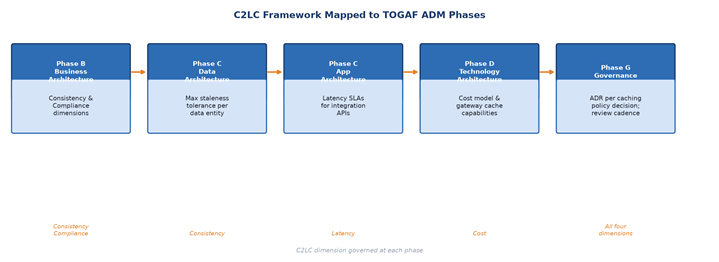
Figure 3 — C2LC dimensions mapped to TOGAF ADM phases B through G
The C2LC framework is most useful when it is embedded in an existing governance cycle rather than operated as a standalone process. TOGAF’s ADM provides that cycle, and the four C2LC dimensions map naturally onto its phases.
Phase B — Business Architecture: Capture business event patterns (batch processing windows, peak transaction periods, year-end cycles) that define peak load profiles and data freshness expectations. Identify regulatory and compliance constraints on data freshness. These inputs define the Consistency and Compliance dimensions for each integration API.
Phase C — Information Systems Architecture (Data): Define data consistency classifications for each shared data entity. Document the maximum staleness tolerance for each consuming system. These classifications become the Consistency governance baseline for caching policy.
Phase C — Information Systems Architecture (Application): Capture non-functional latency requirements for integration APIs. Document the expected call volume patterns. These requirements drive the Latency dimension of caching policy.
Phase D — Technology Architecture: Document API gateway caching capabilities and constraints (TTL ranges, cache invalidation mechanisms, cache storage limits). Develop the cost model for the API gateway layer. These inform the Cost dimension.
Phase G — Architecture Governance: Establish the review process for caching policy decisions. Define which caching decisions require Architecture Review Board sign-off (high-consistency data, compliance-sensitive data, high-cost APIs) versus which can be delegated to team-level governance (low-traffic, low-consistency reference data). Document caching policy decisions as Architectural Decision Records in the Architecture Repository.
The practical value of this mapping is visible in what it changes about the governance process. Table 2 contrasts the caching governance process before and after C2LC adoption.
Table 2 — C2LC Governance: Before and After Comparison
| Governance dimension | Without C2LC | With C2LC |
| Who decides caching policy? | Producing team engineer, unilaterally | Producing and consuming teams jointly, with EA facilitation |
| Where is the decision documented? | In gateway configuration; rarely in architecture artifacts | In an Architectural Decision Record in the Architecture Repository |
| Which ADM phase governs it? | None — caching is outside the ADM cycle | Phase C (consistency/latency), Phase D (cost), Phase G (ARB review) |
| Who reviews compliance implications? | Nobody — compliance is not part of caching decisions | Compliance/DPO function reviews APIs flagged for regulatory freshness constraints |
| What triggers a review of existing policy? | An incident or a TTL-adjustment ticket | Defined review cadence: quarterly for high-risk, annually for low-risk |
This mapping means that caching governance does not require a new process — it requires inserting C2LC decision checkpoints into the ADM cycle that most enterprise architecture teams are already running.
5. Cache Invalidation Patterns and Their Architectural Implications
Cache invalidation is famously described as one of the two hard problems in computer science. In an enterprise architecture context, the difficulty is not primarily technical — it is organizational. The decision about *when* and *how* to invalidate a cache entry involves multiple teams, multiple data ownership boundaries, and multiple governance layers. This section surveys the principal invalidation patterns available to enterprise platform teams and their architectural trade-offs.
5.1 TTL-Based Expiry
TTL-based expiry is the simplest and most widely used invalidation mechanism. The cache entry is assigned a time-to-live at creation time and discarded after the TTL elapses, regardless of whether the underlying data has changed. It requires no event infrastructure, no producer-consumer coordination, and no additional API calls.
The architectural trade-off is a consistency ceiling: the maximum staleness of any cached response is bounded by the TTL, but the actual staleness may be anywhere from zero to TTL. For low-consistency reference data, this ceiling is acceptable. For high-consistency operational data — account status, live transaction records, compliance-sensitive entities — it is not. TTL-based expiry is appropriate as the default invalidation mechanism for C2LC Consistency-Low APIs, and inadequate as the sole mechanism for Consistency-High APIs.
5.2 Event-Driven Cache Invalidation
Event-driven invalidation propagates a cache purge signal to the API gateway when the underlying data changes, expiring the relevant cache entries immediately rather than waiting for TTL expiry. In an event-driven microservice architecture, this is typically implemented via a message broker: the data-of-record service publishes a change event; the API gateway subscribes to the relevant event topic and purges the affected cache key.
The architectural benefit is consistency — the staleness window collapses from TTL to near-zero. The cost is architectural complexity: the producing system must publish change events reliably, the event infrastructure must be highly available, and the cache invalidation logic must correctly identify which cache keys to purge when a given record changes. In complex enterprise data models where a single record update may affect multiple downstream API responses, this key-mapping problem is non-trivial.
Event-driven invalidation is the recommended pattern for C2LC Consistency-High APIs, and its implementation should be governed as a Phase D Technology Architecture decision rather than left to individual service teams.
5.3 Cache Warming and Graduated Invalidation
The cascade invalidation storm described in Section 2.4 is a direct consequence of simultaneous TTL expiry across a high-traffic API. Two patterns mitigate this risk.
*Cache warming* pre-populates the cache before the TTL expiry, using a background process that refreshes cache entries slightly before they expire. The background process absorbs the backend load of the refresh rather than exposing it to the downstream consumer at request time.
*Graduated invalidation* staggers the expiry of cache entries across a time window, either by introducing random jitter into TTL values or by invalidating entries incrementally rather than en masse. This converts the spike load of a simultaneous expiry into a distributed load that the backend can absorb.
Both patterns are implementation choices that require an explicit architectural decision: the team operating the API gateway must choose between them based on the latency sensitivity of the API, the cost of backend calls, and the freshness requirements of the consuming systems. Neither pattern should be selected by default — each represents a trade-off that the C2LC framework’s Cost and Latency dimensions are designed to surface.
5.4 Conditional Requests and Validation Caching
HTTP RFC 9111 defines a conditional request mechanism — ETag and Last-Modified headers — that allows a client to revalidate a cached response against the server without transferring the full response body [5]. If the cached response is still current, the server returns a 304 Not Modified with no body; the client uses its cached copy. If the data has changed, the server returns a 200 with the updated response.
Validation caching is particularly valuable for large API responses (complex entity records, organizational hierarchy payloads, analytics results) where the cost of a full response transfer is high but the data changes infrequently. It is architecturally underused in enterprise platforms because it requires both the API producer and the API consumer to implement the conditional request protocol correctly — a cross-team coordination requirement that is precisely the kind of architectural decision that C2LC governance is designed to manage.
6. C2LC Implementation Roadmap
Adopting the C2LC framework does not require an organization to redesign its entire API gateway layer at once. The most sustainable path is a tiered adoption that starts with the highest-risk APIs and expands as governance processes mature. The following three-stage roadmap reflects a practical adoption sequence.
6.1 Stage 1 — Inventory and Classification (Months 1–2)
The first stage is discovery: building a complete inventory of the integration APIs in the platform and classifying each against the four C2LC dimensions. This is primarily an architectural exercise, not a technical one. The outputs are a C2LC classification register — a structured document in the Architecture Repository that records each API’s Consistency, Cost, Latency, and Compliance classification — and a prioritized list of APIs requiring formal governance review.
Classification should be conducted jointly by the producing team and representative consuming teams, with facilitation from the enterprise architecture function. The most important outcome of this stage is not the classifications themselves but the organizational conversations they require: teams that have never discussed their data freshness requirements with each other are doing so for the first time.
Measurable outcomes for Stage 1: (a) 100% of integration APIs catalogued in the C2LC classification register; (b) a minimum of 80% of producing/consuming team pairs having completed at least one joint classification session; (c) a prioritized list of APIs classified as high-risk (Consistency-High, Compliance-flagged, or high-cost) available for Stage 2 governance review.
6.2 Stage 2 — Governance for High-Risk APIs (Months 3–6)
The second stage applies formal C2LC governance to the APIs identified in Stage 1 as high-risk: Consistency-High, Compliance-flagged, or high-cost APIs. For each of these APIs, the Architecture Review Board reviews the current caching policy against the C2LC classification, approves or requires changes, and documents the decision as an Architectural Decision Record.
The technical outputs of this stage may include: TTL reductions for Consistency-High APIs; event-driven invalidation implementation for APIs where TTL-based consistency is insufficient; compliance-aware cache headers for data-privacy-sensitive APIs; and cost model visibility for high-traffic APIs.
Measurable outcomes for Stage 2: (a) zero high-risk APIs without a documented ADR; (b) mean TTL of Consistency-High APIs aligned to their stated maximum staleness tolerance; (c) all Compliance-flagged APIs with cache-control headers reviewed and signed off by the compliance or data privacy function; (d) a cost model for the API gateway layer established and visible to the ARB.
6.3 Stage 3 — Continuous Governance and Extension (Month 7+)
The third stage embeds C2LC governance into the organization’s ongoing architectural governance cycle. New APIs are classified against C2LC as part of the Phase C design review, before they are deployed. Existing APIs are reviewed on a defined cadence — annually for low-risk APIs, quarterly for high-risk ones. Cache performance metrics from the API gateway layer flow to the Architecture Repository and are reviewed alongside the cost model in the Phase D cycle.
At this stage, the C2LC framework extends beyond the core integration layer to adjacent platform components: analytics data feeds, third-party integration APIs, and internal microservice-to-microservice calls that carry caching policies set by individual development teams.
Measurable outcomes for Stage 3: (a) data consistency incidents attributable to caching policy failures tracked quarterly, with trend visible across governance cycles; (b) cache hit ratio and backend call volume for all C2LC-classified APIs reported in the Phase D Architecture Governance cycle; (c) API review completion rate against the defined cadence (quarterly for high-risk, annually for low-risk) tracked as an ARB governance metric.
7. Discussion
7.1 Applying C2LC in Practice
The most common objection to this kind of framework is that it adds governance overhead to decisions that engineering teams currently make in minutes. This is a real concern, and it is worth being honest about.
Not every caching decision needs to go through an Architecture Review Board. The C2LC framework is designed to be tiered: high-stakes decisions (high-consistency, compliance-sensitive, or high-cost APIs) warrant formal governance; low-stakes decisions (reference data, low-traffic internal APIs) can be governed by team-level conventions documented in the Architecture Repository. The governance investment should be proportional to the architectural risk.
The framework’s primary value is not in slowing down engineering decisions — it is in making visible the decisions that are currently invisible. Most engineering teams do not know which of their APIs carry compliance-sensitive data. Most platform teams do not know the cost of their caching policy. Most enterprise architects do not know which downstream systems are consuming stale data from a cache that was configured two years ago. C2LC creates the organizational vocabulary and the governance hooks to surface these gaps.
7.2 Tooling and Implementation
The C2LC framework is tooling-agnostic, but it pairs naturally with API gateway platforms that provide cache performance analytics. Enterprise API gateway platforms typically expose cache hit ratios and backend call volumes that directly feed the Cost and Latency dimensions of the framework [6]. The key implementation requirement is that these metrics flow to the Architecture Repository — not just into the monitoring dashboards of the team that owns the gateway — so that they are visible to the governance function.
Architectural Decision Records (ADRs) are the natural documentation format for C2LC decisions [10]: a short structured document capturing the API, the four-dimension assessment, the decision made, and the review date. Version-controlling these ADRs alongside the API specifications they govern ensures that caching policy decisions are traceable and auditable.
7.3 Organizational Prerequisites
The C2LC framework assumes a degree of organizational maturity that not all enterprise cloud engineering organizations currently possess. Specifically, it requires that producing and consuming teams can identify each other and have a mechanism for structured dialogue about data requirements — a prerequisite that is absent in heavily siloed organizations. Skelton and Pais [9] identify stream-aligned teams and platform teams as the organizational structures best suited to the kind of cross-boundary governance that C2LC requires; organizations structured differently may find the classification exercise in Stage 1 reveals organizational misalignments that are a prerequisite to governance, not a consequence of it. It also requires that the enterprise architecture function has visibility into the API gateway layer, which is not always the case in organizations where platform infrastructure is managed independently of EA governance. The sociotechnical design principle that technical systems reflect organizational structures [11] applies directly here: caching sprawl is as much an organizational symptom as a technical one.
Where these prerequisites are absent, the Stage 1 inventory and classification exercise described in Section 6.1 serves a secondary purpose: it forces the organizational conversations that make subsequent governance possible. The classification register is both a governance artifact and an instrument for building the cross-team relationships that caching governance depends on.
7.4 Limits of the Framework
C2LC addresses the governance gap in caching policy decisions. It does not address the technical challenges of cache invalidation in event-driven microservice architectures, the implementation complexity of distributed cache coherence, or the performance engineering work required to optimize cache behavior under load. These are engineering problems that require engineering solutions — contract testing frameworks, event-driven cache invalidation patterns, and performance benchmarking disciplines. The framework’s role is to ensure that the right requirements inform those engineering solutions, not to substitute for them.
The framework has not been empirically validated. The implementation roadmap in Section 6 is grounded in enterprise architecture practice and practitioner literature; the framework application in Section 7.6 applies the C2LC classification logic to real, publicly documented APIs and is intended as a demonstration of the framework’s decision logic, not as empirical evidence of its outcomes. Organizations that adopt C2LC governance should treat it as a starting point and adapt it to their specific governance context. Empirical validation — tracking data consistency incidents, infrastructure cost trends, and compliance findings before and after C2LC adoption — is identified as the primary direction for future work.
7.5 Roles and Ownership
The C2LC framework assigns governance responsibilities across five roles. The producing team owns the API contract and is responsible for implementing the cache-control policy approved in the ADR; for Consistency-High APIs, it must also publish change events to the event infrastructure where event-driven invalidation is required. Consuming teams are responsible for declaring their maximum staleness tolerance in the Architecture Requirements Specification and for participating in joint consistency classification sessions; a consuming team that accepts a TTL longer than its business logic can tolerate is accepting an architectural risk it should document explicitly. The enterprise architecture function facilitates the C2LC classification process, convenes the ARB review for high-risk APIs, and maintains the C2LC classification register in the Architecture Repository. The compliance or data privacy function (DPO or equivalent) reviews and approves caching policy for any API flagged as serving personal data or data subject to regulatory freshness constraints; it should not be brought in after a compliance audit identifies a cache-related violation. The platform infrastructure team is responsible for gateway configuration, cache tier sizing, and cost monitoring; critically, it should expose cache hit ratios and backend call volumes to the Architecture Repository rather than retaining them solely in operational monitoring dashboards. Cross-cutting incident response — when a stale-data failure is detected in production — should follow a defined escalation path that involves the producing team, consuming team, and EA function, explicitly preventing the standard pattern of TTL adjustment and closure without architectural review.
7.6 Hypothetical Application: HCM–Finance Integration on a Shared API Gateway
The following scenario illustrates C2LC governance applied to a hypothetical enterprise running SAP SuccessFactors for Human Capital Management integrated with SAP S/4HANA for Finance and Payroll on SAP BTP Integration Suite with API Management [16]. This integration topology is a documented reference architecture pattern representative of large-scale enterprise deployments. The three APIs used in this walk-through — EmpJob, FOCostCenter, and A_SlsPricingConditionRecord — are real, publicly documented endpoints available on the SAP Business Accelerator Hub [16]; their governance classifications are derived from the documented data semantics of those APIs. Specific TTL values are illustrative and would require calibration against actual deployment volumes, SLA agreements, and regulatory jurisdiction in a production context. This walk-through is intended to demonstrate the framework’s application logic, not to provide empirical validation of its effectiveness.
Scenario context. The enterprise’s integration layer exposes three APIs across module boundaries:
(1) `EmpJob` (Employment Status API, SAP SuccessFactors Employee Central) — consumed by S/4HANA Payroll, Benefits Administration, and Talent Management. This API carries employment status, job classification, and effective dates for all active employees.
(2) `FOCostCenter` (Cost Center Hierarchy API, SAP SuccessFactors) — consumed by S/4HANA Finance and Procurement. This API carries the organizational cost center hierarchy used for financial posting and budget allocation.
(3) `A_SlsPricingConditionRecord` (Sales Pricing Condition API, SAP S/4HANA) — consumed by the Quotation Engine and Customer-Facing Portal. This API carries contract pricing, promotional conditions, and customer-specific discounts.
C2LC classification and governance outcomes.
*EmpJob:* Consistency — High. Employment status changes (new hire, termination, leave of absence) must propagate to Payroll before the next payroll processing run; a stale status can result in payment to a terminated employee or absence of a new hire’s first payroll cycle. Cost — High traffic during payroll processing windows, with a characteristically bursty pattern rather than steady-state load; caching reduces redundant queries from the three consuming modules querying the same record concurrently. Compliance — Personal data subject to applicable data privacy regulations; under data erasure obligations in relevant jurisdictions [14], employee records flagged for deletion must not continue to be served from cache after deletion is confirmed. Latency — Manager self-service dashboards are latency-sensitive; payroll batch processing is latency-insensitive. *Governance outcome:* ARB sign-off required (Consistency-High, Compliance-flagged). Event-driven invalidation recommended where event infrastructure (such as SAP Event Mesh or equivalent) is deployed; otherwise a short-window TTL (not exceeding the payroll processing cycle boundary) with DPO-reviewed cache headers. ADR to be stored in the Architecture Repository with a quarterly review date.
*FOCostCenter:* Consistency — Low. Cost center hierarchies change during budget planning cycles, typically once per financial year. Cost — Moderate traffic; significant cache offload potential for hierarchy traversal queries issued by multiple Finance and Procurement consumers. Compliance — No personal data; no regulatory freshness constraint. *Governance outcome:* Team-level documentation. Long-window TTL (24 hours) appropriate; the review cadence aligns to the annual budget planning cycle. No ARB review required.
*A_SlsPricingConditionRecord:* Consistency — High. Promotional pricing updates and contract-specific price overrides must be reflected immediately in quotations; a stale cached price results in an incorrect pricing commitment to the customer, creating contractual and financial exposure. Compliance — Tax condition components must reflect current applicable jurisdiction rates; serving a superseded tax rate from cache can constitute a billing compliance issue. *Governance outcome:* ARB sign-off required (Consistency-High, Compliance-flagged). Short TTL or event-driven invalidation tied to pricing master data change events; compliance function review of tax-component cache headers.
Observation. The three APIs in this scenario receive differentiated governance outcomes from the same framework: one requiring ARB sign-off and event-driven invalidation, one requiring only team-level documentation with a long TTL, and one requiring ARB sign-off with a compliance function review. This differentiation is C2LC’s primary operational contribution — it ensures governance overhead is proportional to architectural risk rather than applied uniformly across all caching decisions.
8. Conclusion
API caching is not a footnote in enterprise architecture. In large-scale enterprise cloud platforms, it is one of the mechanisms through which data consistency guarantees are made or broken, infrastructure costs are controlled or inflated, and compliance obligations are met or violated. Treating it as an engineering implementation detail — something to be configured by the team that owns the API and forgotten — leaves a significant architectural risk ungoverned.
The C2LC framework proposed in this paper offers a practitioner-oriented model for bringing caching policy into the EA governance cycle. By mapping the four dimensions of caching governance — Consistency, Cost, Latency, and Compliance — onto TOGAF’s ADM phases, and by providing a tiered implementation roadmap that scales governance to architectural risk, it gives enterprise architects a structured way to ask the right questions about caching decisions without requiring them to become caching engineers.
The failure patterns described in Section 2.4 — stale master records, cascade invalidation storms, and compliance lags — are recognizable to any practitioner who has operated a large enterprise cloud platform at production scale, and are documented in distributed systems practitioner literature [12,13]. The C2LC framework is a response to those patterns, grounded in TOGAF governance principles and informed by HTTP caching standards and enterprise integration practice.
The next step is empirical validation. Organizations that adopt C2LC governance for their API gateway layer should track data consistency incidents, infrastructure cost trends, and compliance audit findings before and after adoption. The framework proposed here is a starting point — intended to be refined by the practitioners who put it to work.
Declarations
Competing Interests: The author declares no competing interests.
Grant Information: No grants supported this work.
Data Availability: No data are associated with this article.
References
- 1. Hohpe G, Woolf B. *Enterprise Integration Patterns: Designing, Building, and Deploying Messaging Solutions*. Boston: Addison-Wesley; 2003.
- 2. Richardson L, Ruby S. *RESTful Web Services*. Sebastopol, CA: O’Reilly Media; 2007.
- 3. The Open Group. *TOGAF Standard, Version 9.2*. Reading: The Open Group; 2018.
- 4. Fielding RT. *Architectural Styles and the Design of Network-based Software Architectures* [dissertation]. Irvine: University of California; 2000.
- 5. Fielding R, Nottingham M, Reschke J. *HTTP Caching. RFC 9111*. Internet Engineering Task Force; 2022.
- 6. Amazon Web Services. API Gateway Developer Guide: Enabling API Caching to Enhance Responsiveness. AWS Documentation; 2024. Available: https://docs.aws.amazon.com/apigateway/latest/developerguide/api-gateway-caching.html
- 7. Forsgren N, Humble J, Kim G. *Accelerate: The Science of Lean Software and DevOps*. Portland: IT Revolution Press; 2018.
- 8. Conway ME. How do committees invent? *Datamation*. 1968;14(4):28–31.
- 9. Skelton M, Pais M. *Team Topologies: Organising Business and Technology Teams for Fast Flow*. Portland: IT Revolution Press; 2019.
- 10. Tyree J, Akerman A. Architecture decisions: Demystifying architecture. *IEEE Software*. 2005;22(2):19–27.
- 11. Cherns A. The principles of sociotechnical design. *Human Relations*. 1976;29(8):783–792.
- 12. Newman S. *Building Microservices: Designing Fine-Grained Systems*. 2nd ed. Sebastopol, CA: O’Reilly Media; 2021.
- 13. Nygard MT. *Release It! Design and Deploy Production-Ready Software*. 2nd ed. Raleigh: Pragmatic Bookshelf; 2018.
- 14. European Parliament and Council of the European Union. Regulation (EU) 2016/679 of the European Parliament and of the Council (General Data Protection Regulation). *Official Journal of the European Union*. 2016;L 119:1–88. Available: https://eur-lex.europa.eu/legal-content/EN/TXT/?uri=CELEX:32016R0679
- 15. DORA/Google Cloud. *State of DevOps 2024*. Google Cloud; 2024. Available: https://cloud.google.com/devops/state-of-devops
- 16. SAP SE. SAP Business Accelerator Hub. Available: https://api.sap.com. Accessed 2024.
About the Author
Satish Chavali is a Senior Engineering Manager at SAP America, Inc., with expertise spanning enterprise architecture, platform engineering, DevOps, and large-scale cloud applications. His work focuses on designing and evolving the foundational technology platforms that enterprise systems depend on, with particular depth in API gateway architecture, secrets and configuration management, scalability, and cloud operations. He brings a practitioner perspective to enterprise architecture — connecting architectural principles and frameworks to the realities of operating complex systems at scale. His current research interests include the application of AI in engineering and operations, viewing it as an accelerator for architectural decision-making and operational intelligence rather than a replacement for engineering expertise.