
Gartner’s latest CEO survey exposes a troubling disconnect between escalating AI investments and demonstrable business value. It also presents an extraordinary opportunity for Enterprise Architecture to become indispensable to executive leadership—provided the profession can overcome its own longstanding difficulties with credibility, sponsorship, and measurable returns.
An Uncomfortable Paradox at the Heart of the AI Revolution
As thousands of business and technology leaders gather in Orlando for Gartner IT Symposium/Xpo 2026, a paradox hangs over the excitement surrounding artificial intelligence: If AI is designed to make enterprises more intelligent, productive, and competitive, why are so many organizations struggling to demonstrate meaningful financial returns?
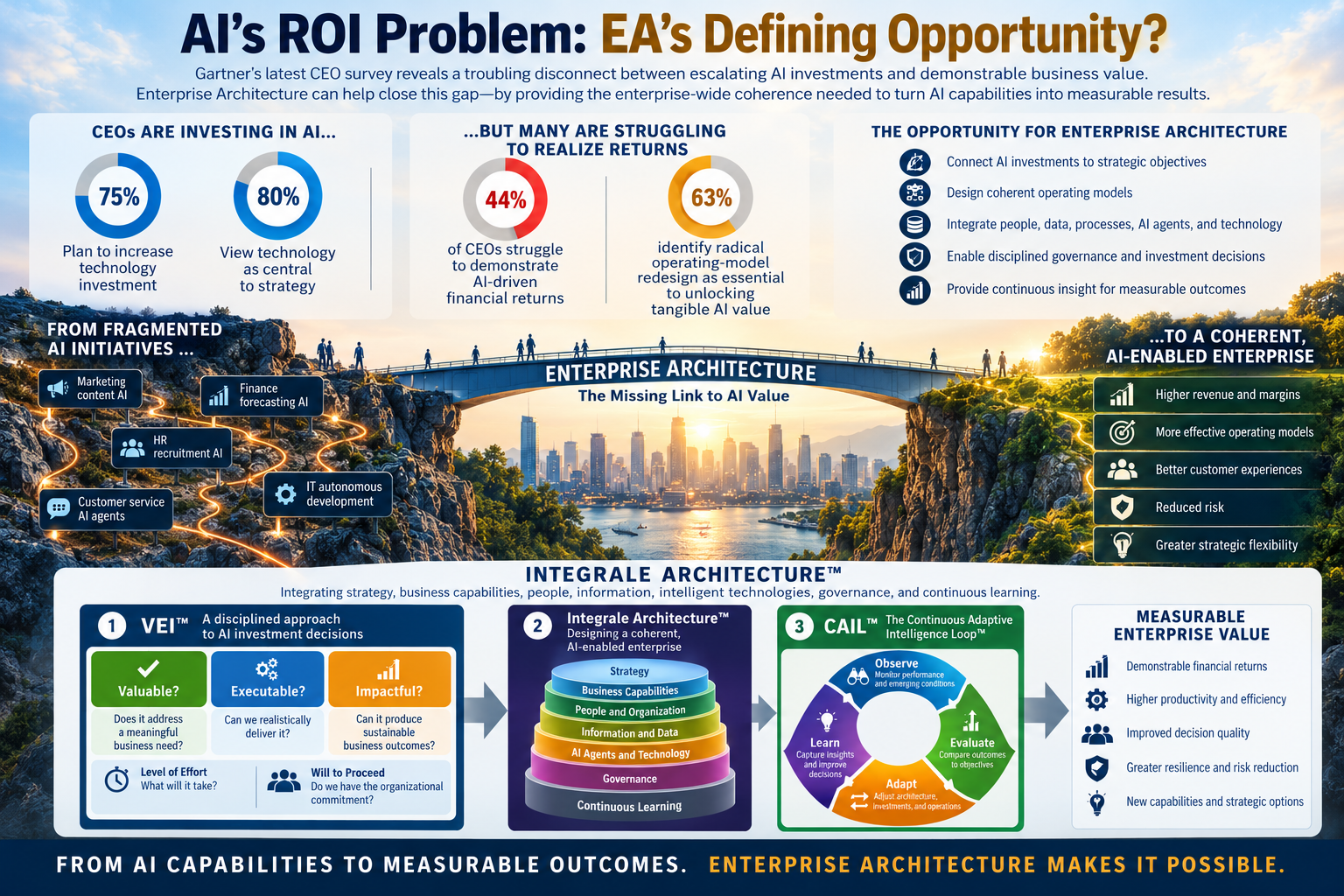
Gartner’s newly released 2027 CEO Survey brings this tension into sharp focus. According to Gartner, 44% of CEOs struggle to demonstrate AI-driven financial returns, even as 75% plan to increase technology investment and 80% view technology as central to strategy. Most strikingly, 63% identify radical operating‑model redesign as essential to unlocking tangible AI value.
These findings reveal a widening gap between the powerful technologies organizations are acquiring and their ability to translate those technologies into sustained enterprise performance. The issue is not that AI is failing. As the document notes, “there is abundant evidence that AI can perform remarkable tasks… yet enterprises may be introducing revolutionary technologies into organizational structures… that remain largely unchanged.”
Under such conditions, even impressive local improvements fail to produce enterprise‑level benefits. This is precisely where Enterprise Architecture (EA) should shine—and where its longstanding credibility challenges become impossible to ignore.
Why AI Success Does Not Automatically Produce Enterprise Success
AI typically enters organizations through isolated initiatives: marketing accelerates content creation, finance deploys forecasting tools, HR experiments with AI-assisted recruitment, customer service adopts conversational agents, and IT introduces autonomous capabilities into development and operations.
Each initiative may succeed on its own terms. Yet the enterprise often remains fragmented, with inconsistent information, unclear decision rights, overlapping investments, and governance mechanisms unprepared for increasingly autonomous technologies.
The document captures this dynamic clearly: “Optimizing individual components does not automatically optimize the whole.” AI magnifies this systems problem. Accelerating one activity does not eliminate upstream or downstream bottlenecks. Improving one decision does not guarantee coherence across the enterprise. And deploying autonomous agents introduces cross-functional dependencies that traditional governance cannot manage.
The central challenge is no longer identifying tasks AI can perform—it is determining how the enterprise should function when intelligent human and machine capabilities become deeply interconnected. That challenge is fundamentally architectural.
Gartner’s Findings and the Unfulfilled Promise of Enterprise Architecture
Gartner’s October 19 research on the 2027 CIO and Technology Executive Agenda reinforces the CEO survey’s implications. Only 13% of CIOs report significant or transformational value from AI, and stronger performance correlates with disciplined governance—especially the ability to halt unsuccessful pilots and discontinue initiatives that no longer justify investment.
These findings do not suggest that EA alone determines AI success. But they do highlight enterprise-wide responsibilities—operating-model design, governance, investment discipline—that EA is uniquely positioned to support. Yet EA has not consistently delivered on this promise.
Too often, EA becomes synonymous with frameworks, repositories, standards, and compliance rituals. These instruments matter, but they do not constitute value. As the document states, “An architecture model that never influences a consequential decision may contribute little to enterprise performance.”
Executives do not seek more diagrams—they seek better decisions, reduced uncertainty, and confidence that investments will produce intended results. To meet this moment, EA must evolve from alignment to enterprise coherence: ensuring that capabilities, decisions, information, governance, and operating mechanisms work together purposefully and adaptively.
Integrale Architecture™ and the Pursuit of Enterprise Coherence
Integrale Architecture™ (see https://IntegraleArchitecture.com) extendsarchitectural thinking beyond traditional boundaries. Its core proposition is that effective architecture must integrate strategic intent, business capabilities, organizational structures, information, human expertise, intelligent technologies, governance, and continuous learning into a coherent enterprise-wide system.
Two concepts—VEI™ and CAIL™—offer particularly relevant mechanisms for addressing the AI ROI challenge.
VEI™: Valuable? Executable? Impactful?
VEI reframes investment evaluation around three questions:
- Valuable? Does the initiative address a meaningful business need or strategic objective?
- Executable? Does the enterprise possess the capabilities, resources, information, governance, and commitment required for success?
- Impactful? Will the initiative produce consequential, sustainable outcomes?
VEI also incorporates Level of Effort and Will to Proceed, acknowledging that organizational commitment—not just technical feasibility—determines success. This approach exposes conditions under which AI investments can succeed or fail. As the document notes, “Ignoring these realities can turn a promising investment into a costly disappointment.”
CAIL™: Continuous Adaptive Intelligence Loop
CAIL addresses the need for ongoing learning and adaptation. AI-enabled enterprises are dynamic—models evolve, costs shift, responsibilities change, and operating conditions fluctuate. Architecture can no longer be a periodic activity. CAIL provides a mechanism for:
- observing enterprise conditions
- evaluating performance against intended outcomes
- identifying emerging constraints and opportunities
- adapting architectural decisions continuously
Together, VEI and CAIL establish a disciplined relationship between investment selection, architectural design, execution, and value realization.
The Economics and Governance of the AI-Shaped Enterprise
AI forces organizations to reconsider the economics of work, autonomy, information access, and risk. Architectural decisions influence integration costs, reuse potential, resilience, speed-to-market, and adaptability—yet these impacts are rarely measured. The document highlights this gap: “Many organizations lack systematic methods for translating architectural consequences into financial terms.”
EA must therefore strengthen its connection to financial management and benefits realization. Productivity improvements do not automatically translate into cash savings. Decision quality, resilience, and strategic flexibility matter—but must be evaluated credibly.
Governance must also evolve. Compliance remains essential, but governance should become an instrument of value assurance, examining whether initiatives are valuable, executable, impactful, and aligned with enterprise circumstances.
Earning Executive Sponsorship Through Demonstrated Value
The EA profession must rethink how it earns executive sponsorship. Asking leaders to fund architecture because it is “important” is no longer viable—especially when organizations already question returns from major technology investments. A more credible approach is to demonstrate value through focused, time‑bounded engagements.
One proposed model is a 90‑Day AI Value Assurance Initiative, jointly sponsored by business, technology, and finance leaders. Over three months, a multidisciplinary team would:
- establish baselines, objectives, dependencies, and constraints
- evaluate architectural and operating-model alternatives using VEI
- implement feasible improvements and prepare evidence-based executive recommendations
The deliverable is not a repository—it is a decision package demonstrating how architectural insight improves investment choices.
This reverses the sponsorship proposition: executives evaluate architecture based on its contribution to urgent problems, not on abstract promises.
A Defining Opportunity for the EA Profession
AI is reshaping how enterprises operate, decide, learn, and adapt. The rise of autonomous agents makes coherence, accountability, and economic discipline indispensable.
This creates a defining opportunity for EA—but only if the profession evolves.
Architects must work across organizational boundaries, engage directly with financial and operational decisions, and evaluate alternatives in terms executives recognize. Architectural capability must be distributed across the enterprise, with professional architects connecting perspectives, exposing interdependencies, and enabling coherent decisions.
Integrale Architecture™, supported by VEI™ and CAIL™, offers one path forward. Its significance lies not in new terminology, but in strengthening the connection between architecture, strategy, investment accountability, execution, and continuous learning.
The next step is practical validation—methods, instruments, patterns, and measurable improvements.
Conclusion: From Architectural Activity to Consequential Architecture
Gartner’s findings reveal a profound truth: enterprises cannot achieve AI value without redesigning the systems in which AI operates.
As the document concludes, “The fact that 44% of CEOs struggle to demonstrate AI-driven financial returns, while 63% prioritize radical operating-model redesign, should command the attention of every enterprise architect.”
The future of EA will not be defined by models, repositories, or compliance—it will be defined by demonstrable improvements in enterprise decisions and outcomes.
The AI revolution may be the greatest opportunity EA has encountered in decades. But it will only become a defining moment if architects prove they are part of the solution to the value‑realization problem—not another investment whose value remains difficult to establish.
About the Author
Dr. Steve Else is an Enterprise Architecture thought leader, founder of EAPJ and a longtime contributor to and observer of the evolution of business and technology architecture. His work spans EA, solution architecture, governance, organizational effectiveness, and emerging approaches to AI-enabled enterprise management.
He is developing Integrale Architecture™ to capture some of his latest thinking on EA, including VEI™ and the Continuous Adaptive Intelligence Loop™ (CAIL™), to strengthen the connection between architectural thinking, executive decision-making, and enterprise value. https://IntegraleArchitecture.com